
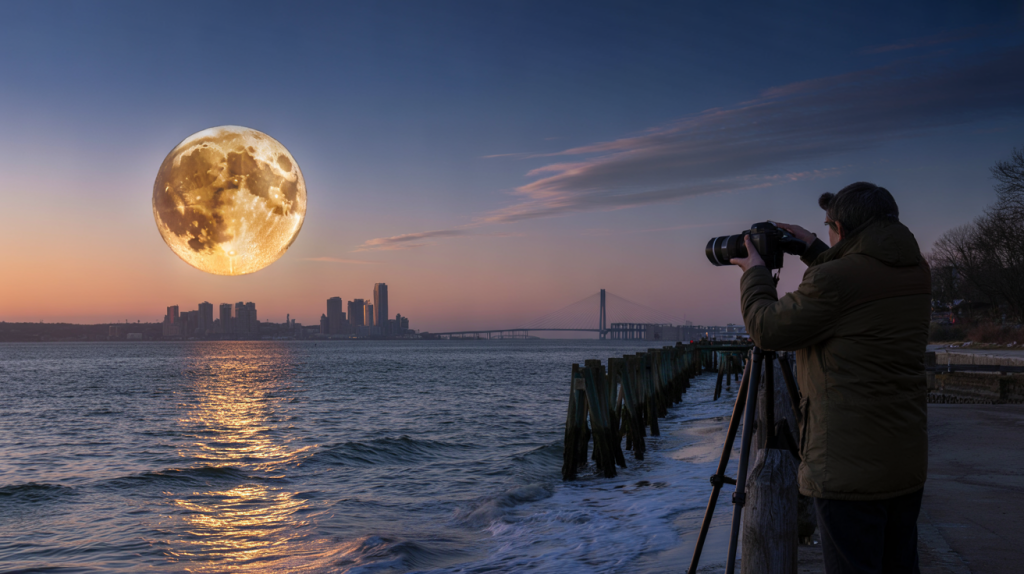
Look up on Friday 5 December 2025: a striking full Moon will rise around sunset and set near sunrise, drawing eyes across the sky. Many popular calendars list it as a “supermoon”, which means the full Moon happens close to its monthly perigee and looks a touch larger and brighter than usual.
Labels vary by definition. Some outlets count only the very closest full Moons, others include any that fall near the top range of closeness. Either way, the view delivers. Expect a big, golden disc at moonrise, a colder white at midnight, and an easy, phone-friendly target for photos.
Supermoon 5 December 2025 : what to expect tonight
The term points to a simple idea: the Moon’s orbit is not a perfect circle. When the full phase occurs near perigee, the Moon’s apparent size grows slightly and its light increases. To the eye, the difference is subtle on its own, yet it pops when the Moon sits low over buildings, trees, or water.
Timing is straightforward. Step outside around your local sunset for moonrise, again near midnight when the Moon rides highest, and before dawn for moonset. The disc looks full to most of us for about 24 hours, so if clouds crash your plans at dusk, try late evening or the next morning.
Coastal residents watch the tides. The National Oceanic and Atmospheric Administration notes that full or new Moons near perigee can bring “perigean spring tides”, which are higher than typical spring tides and sometimes push minor coastal flooding during onshore winds. Check your local tide tables if planning shoreline photos.
Why the Moon looks bigger : science, sizes and brightness
Here is the physics, no jargon. The Moon swings between perigee at about 363,300 km and apogee near 405,500 km from Earth according to NASA. That change in distance alters the apparent diameter we see.
NASA explains that a perigee full Moon can appear up to about 14 percent larger and roughly 30 percent brighter than a full Moon at apogee. Not compared to a typical full Moon on a random night, but to the smallest full Moon of the year, sometimes called a “micromoon”. The difference is real, just not dramatic without a side by side.
The rhythm behind it is steady. The full Moon comes once every synodic month of about 29.53 days, while perigee and apogee cycle on their own schedule. When those two cycles line up, we get what popular media call a supermoon. Also, that feeling the low Moon looks enormous over the horizon has a name: the Moon illusion. Our brains boost the size when there is foreground for comparison.
How to watch on 5 December 2025 : timing, photos, cities
Start with location. A clear eastern horizon at sunset gives the iconic golden rise over a city skyline or a calm lake. Urban viewers can use a park or a bridge with a clean view. Rural viewers can frame a barn, a tree line, or distant hills. Safety first near traffic or water, of course.
For precise local times, use an official almanac or a reputable service such as the U.S. Naval Observatory or timeanddate. Plug in your city to get moonrise and moonset down to the minute. The Moon will look full the night of 5 December and still nearly full the following night if weather improves.
Phones do fine with the Moon when you manage exposure. Tap the Moon on screen to focus, then drag exposure down until details appear. Turn off flash. If your phone offers a “Pro” mode, set ISO low and shorten the exposure so the disc is not blown out. A small tripod or a wall helps avoid blur.
Want a landscape with a big Moon? Stand far from your subject. Telephoto lenses compress distance, making the Moon look larger behind buildings or mountains. Scout a spot in daylight, use a map app with elevation, and arrive early. That plan has saved many shots that would have otherwise occured in a rush.
Eyes are safe when looking at the Moon, no filters needed. Binoculars reveal craters along the terminator, even at full phase where shadows are short. If you live by the coast, check NOAA tide predictions before stepping onto piers or low promenades, especially if onshore winds coincide with the evening high tide.
If clouds win the night, do not toss the plan. The Moon’s cycle guarantees another full phase about 29.53 days later, and the view the next morning can be unexpectedly beautiful as the Moon sinks into pastel dawn colors.