
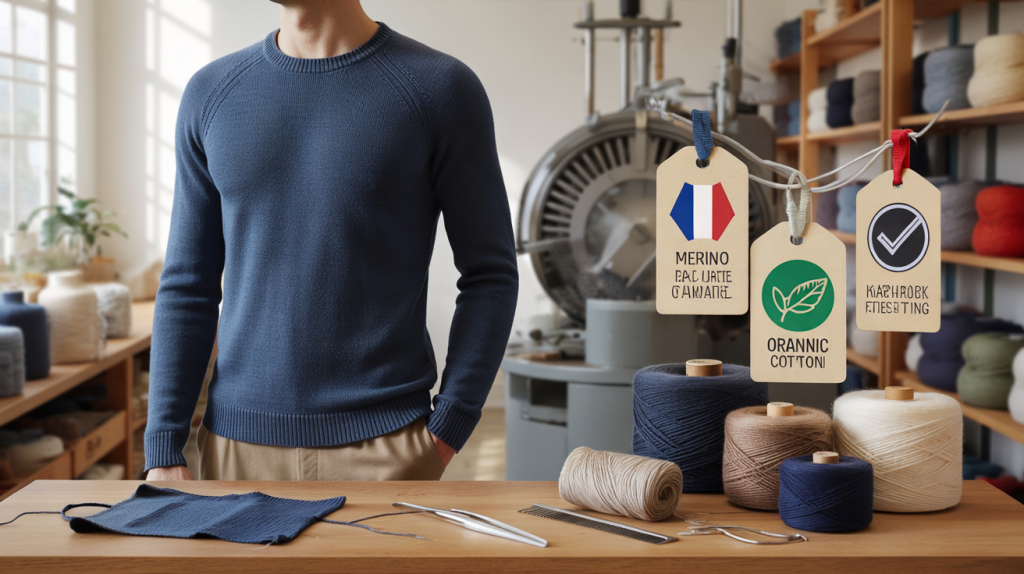
Meta description: Looking for the ideal French sweater? Materials, labels, fits and care decoded. Make the right choice with facts and smart checks.
Looking for the ideal French sweater that looks sharp, feels good, and truly lasts. The answer is not only about style, it starts with where and how the knit is made, the fibers inside, and the proof stamped on the label.
The market has exploded with options branded as French. Some are fully made in France. Others only design here. The difference shows in durability, comfort and price transparency. The goal is simple: spot the sweater that delivers warmth, breathability and a clean silhouette, backed by verifiable guarantees, not buzzwords.
Ideal French sweater: what really matters now
A good knit does three jobs at once. It regulates temperature, it drapes properly, and it survives seasons of wear without pilling fast. The best French brands align all three with consistent yarn quality, tight knitting and finishing done locally.
The stumbling block often sits in the fiber mix. Choose right and the sweater breathes and resists odors. Choose wrong and it feels clammy by noon. Merino and high grade cotton hold shape better than low cost blends that rely on heavy synthetic content.
Fit still decides the look. Shoulder seams that sit at the bone, sleeves that hit the wrist, a hem that rests mid hip. That clean line makes a crewneck or a roll neck look effortless, not bulky.
Materials that perform: merino, cashmere, recycled yarns
Merino remains the smart everyday choice. The Woolmark Company explains that merino fibers are fine by design and help manage moisture through the day, which supports comfort during temperature shifts. That breathability is what keeps a commute or an office day under control.
Cashmere is softer to the touch, yes, and warmer for the weight. Quality varies a lot though. Finer fiber does not automatically mean better knit if the yarn is overspun or the gauge is too loose. Recycled cashmere blends can improve durability when spun with virgin wool, while cutting the footprint of raw fiber extraction, an approach shared by many responsible French labels.
For skin sensitivity, long-staple cotton knits help in spring and indoors. Organic cotton certified by GOTS offers a clearer audit trail on environmental criteria. The Global Organic Textile Standard specifies that products labeled “organic” must contain at least 95 percent certified organic fibers, while “made with organic” must contain at least 70 percent. That threshold matters when comparing tags in store.
Proof on the tag: Origine France Garantie, GOTS, OEKO-TEX
When a brand says French, look for “Origine France Garantie”. Pro France created this label in 2011 to clarify origin claims. The standard states that the essential characteristics of the product must be achieved in France and that between 50 and 100 percent of the unit cost price is French. This percentage is a concrete filter for truly local manufacturing.
For safety and skin contact, OEKO-TEX Standard 100 has tested textiles for harmful substances since 1992, according to the International Association for Research and Testing in the Field of Textile and Leather Ecology. Seeing this label on a sweater or on the yarn used is a quick signal that the item meets chemical limits set by the scheme.
On the environmental side of fibers, GOTS remains the most recognized global standard for organic textiles. Its criteria cover the entire chain, from fiber processing to labeling. That avoids the usual confusion between a sustainable marketing message and a certified process.
How to choose your French sweater in 30 seconds
A quick, practical checklist helps when the shelves are full and time is short.
- Origin clarity: look for “Origine France Garantie” and a traceable factory location, ideally city and workshop.
- Fiber first: merino for daily wear, cashmere for softness, organic cotton for sensitive skin, recycled blends for durability and impact balance.
- Hand feel test: rub sleeve against body to gauge pilling risk, stretch cuff gently and check if it springs back.
- Gauge and weight: midweight knits keep shape better for work and travel, very loose knits bag out faster.
- Care plan: label should indicate cool hand wash or delicate machine cycle, plus flat dry. If care seems cryptic, skip.
Price becomes clearer once materials and proof are aligned. A French-made merino crew with certified yarn and controlled finishing will sit higher than a basic import, and that makes sense. Transparent brands share their workshop partners and sometimes the knit gauge. That sort of detail usually correlates with better longevity.
A last word on comfort during the week. Breathable fibers regulate microclimate between skin and knit, which reduces the urge to layer excessively. That is where merino often wins. It also pairs well with tailoring, because the fabric returns to form after movement. Small thing, big effect.
For anyone hesitating between two models, trust the trio of tests. Verified labels and dates, a fiber story that holds up, and a simple fit check at the mirror. Get those right and the ideal French sweater stops being a myth and becomes a reliable staple, definitly wearable from Monday to Sunday.