
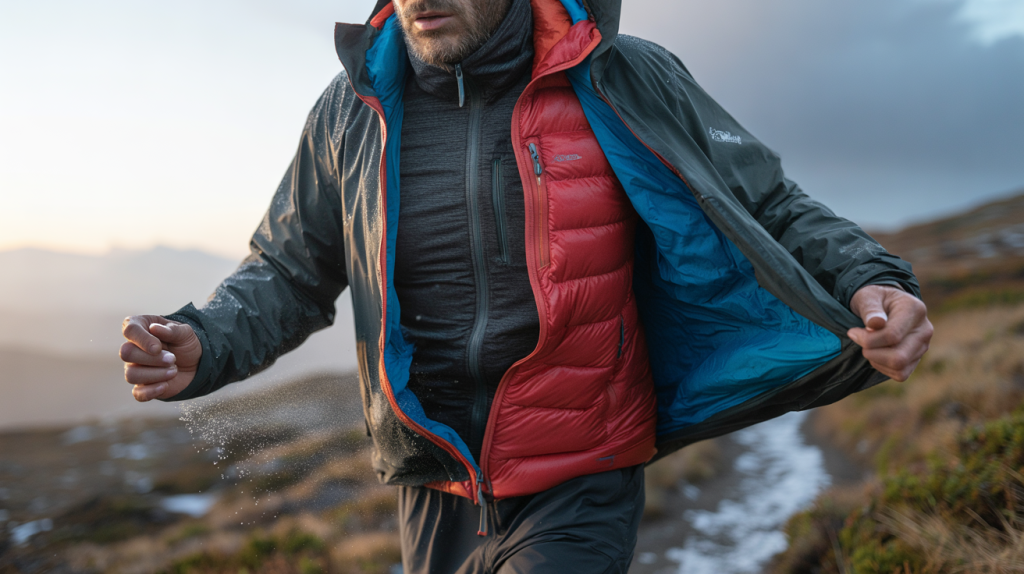
Shivering at the stoplight, sweating five minutes later on the climb. That whiplash between cold and heat ruins winter outings and daily commutes alike. The fix making the rounds in outdoor circles has a quirky name : the “jacket sandwich”.
The idea is simple and fast to use on the move. Build layers that let heat escape the moment you warm up, then trap it again when you slow down. Unlike the classic three-layer stack, this technique treats a wind or rain shell like the “filling” that moves position, so warmth and breathability stay balanced without a full wardrobe change.
What is the Jacket Sandwich Technique ?
At its core, this method blends the familiar base-mid-shell system with one tweak : the shell can sit under or over insulation depending on effort and weathr. When working hard in cold, dry air, slip a thin wind shell over a wicking base, then add a light puffy or fleece on top. When rain or heavy snow arrives, move the shell to the outside in seconds.
That shuffle changes how air and moisture travel. A shell under insulation blocks wind and holds a thin warm microclimate, while the outer puffy buffers cold spikes. On a stop, throw a belay-style jacket over everything. Back to moving, peel that top insulation and keep the wind protection on without starting from zero.
Why this layering works : science, fabrics, numbers
The physics are not exotic. Evaporation and wind steal heat quickly, which is why the U.S. National Weather Service notes hypothermia can develop at temperatures above 40°F when you are wet and it is windy (NWS Wind Chill guidance).
Materials matter. REI Co‑op’s Expert Advice describes the three-layer system as base for moisture, mid for insulation, shell for weather protection, a framework that this technique reorganizes to match effort. It keeps sweat moving out while trimming wind chill before it bites.
Shell tech helps. W. L. Gore reports that a Gore‑Tex membrane contains about 9 billion pores per square inch, each roughly 20,000 times smaller than a liquid water droplet yet about 700 times larger than a water vapor molecule (Gore company materials). That gap lets sweat vapor escape while blocking rain, which is exactly what a “filling” shell needs to do.
Insulators play distinct roles. The Woolmark Company states merino wool can absorb up to around 30 % of its dry weight in moisture while remaining comfortable, useful when effort spikes. For high loft at low weight, down is sized by fill power, measured in cubic inches per ounce – for example, an 800‑fill jacket traps more air per ounce than a 600‑fill piece (REI Co‑op, Down Insulation explainer).
How to build your jacket sandwich step by step
Set it up once, then adjust by touch without a full stop.
- Start with a snug, long‑sleeve base : synthetic or merino, no cotton.
- Add a featherlight wind shell next to it : full‑zip, under 120 g if possible, with pit or core vents.
- Top with active insulation : breathable fleece or synthetic puffy for moving, a loftier puffy held in the pack for full stops.
- When precipitation starts, move the rain shell to the outside fast : unzip outer layer, slip shell over, put insulation back on if needed.
- Vent in motion : crack zips 2‑5 cm, pop cuffs, or open the chest to dump steam on climbs.
- At rests, throw a big “belay” jacket over everything : no heat lost to fiddling with inner layers.
Common mistakes and quick fixes
Wearing the shell outside by default on dry, cold days often traps too much moisture. Swap it under the insulating layer during hard efforts so sweat can keep moving out while wind stays muted.
Choosing the wrong midlayer makes the stack feel swampy. Fleece breathes predictably; dense softshells can bottleneck vapor. For high-output days, prioritize air‑permeable pieces marketed as “active insulation”.
Ignoring fit kills the effect. A puffy that is too tight compresses the underlying shell and reduces loft. Leave a finger of ease in shoulders and chest so air can warm up without dead weight.
Forgetting hand and head vents is another snag. Small openings do big work. Crack the main zip and remove a beanie on climbs; that simple change can feel like dropping several degrees without touching the core.
Real‑world use cases : hiking, cycling, city commutes
Hiking in shoulder season changes fast. Climb with base plus wind shell, stash the breathable puffy on top only for ridge breaks. If sleet rolls in, pull the rain shell outside and keep moving dry.
Urban riders face stop‑and‑go heat swings. A thin wind layer against the jersey cuts bite on flats. At lights, a synthetic puffy goes on in seconds, then packs down small when the pedals spin again.
On a sub‑freezing dog walk, the same move applies. Shell near the base keeps gusts from chilling the torso, while a roomy parka over the top handles idle time. No drama, no clammy reset when activity resumes.
One last detail ties it together : place small items in chest pockets you can access regardless of which jacket sits outside that minute. The sandwich works best when hands find zips and snacks without a second thought.