
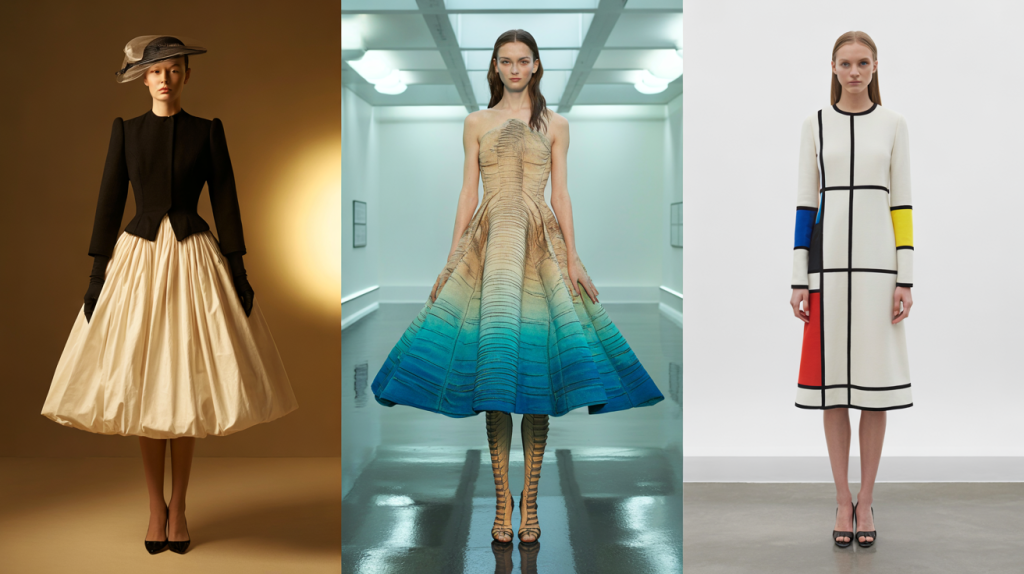
Some runway moments do more than impress. They reset what beauty looks like, feel unforgetable, and keep pulling crowds decades later. Ask curators and historians which collections recur, and the same names surface fast : Christian Dior’s 1947 “New Look”, Alexander McQueen’s Spring Summer 2010 “Plato’s Atlantis”, and a handful of modern classics.
The debate sounds subjective, yet the trail is practical : dates, yards of fabric, sold‑out exhibitions, even early livestream numbers. Dior’s debut on 12 February 1947 recast postwar silhouettes with skirts that used up to 20 yards of cloth, a shock recorded by The Metropolitan Museum of Art. McQueen closed the 2000s by fusing tech and myth, then drew 661,509 visitors to the 2011 “Savage Beauty” exhibition at the Met between 4 May and 7 August, according to the museum. Beauty leaves data behind.
Dior 1947 “New Look” : a postwar reset with curves and yards
Context first. Postwar austerity still shaped wardrobes in early 1947. Dior’s Corolle line, nicknamed “New Look” by editor Carmel Snow, arrived with cinched waists, rounded shoulders, and sweeping skirts that signaled abundance. The Met’s Heilbrunn Timeline notes skirts requiring up to 20 yards, an extravagance after rationing.
Impact followed immediately. Paris regained its fashion capital aura as buyers and editors relayed the silhouette worldwide. The look defined much of the 1950s and anchored the house of Dior for decades, a measurable staying power in museum collections and fashion textbooks that routinely place 1947 as a turning point.
Numbers back that aura. France officially lifted many apparel rationing measures by late 1946, while the United Kingdom kept clothing coupons until 1949. That timing amplified the shock value of fullness and gave the collection historic clarity in calendars as well as closets. Sources : The Metropolitan Museum of Art; UK National Archives.
Alexander McQueen Spring Summer 2010 “Plato’s Atlantis” : digital theatre becomes couture
Fast forward. McQueen showed “Plato’s Atlantis” in October 2009 for the Spring Summer 2010 season in Paris, wrapping a survival-of-the-species story in precision prints and towering “Armadillo” shoes. The production pioneered the live runway stream, hosted by SHOWstudio.
Then a real‑time jolt. A late tweet from Lady Gaga teased “Bad Romance”, sending traffic spikes that crashed the stream, reported by British media at the time. Months later, McQueen’s legacy translated into footfall : the Met’s 2011 “Alexander McQueen : Savage Beauty” drew 661,509 visitors in 100 days, one of the museum’s most visited exhibitions on record, per The Metropolitan Museum of Art.
Seen today, the collection blends craft and code. Digital prints mapped perfectly onto engineered dresses, while the show rewired how audiences watch fashion. That mix of technique and reach gives “Plato’s Atlantis” a factual claim on twenty‑first century beauty.
Yves Saint Laurent 1965 “Mondrian” : modern art made wearable
Not all icons rely on spectacle. In 1965, Yves Saint Laurent distilled Piet Mondrian’s grids into six wool jersey day dresses with impeccably matched seams. The dresses appeared on magazine covers that autumn, embedding high art inside daywear without a single logo shouting for space.
The Victoria and Albert Museum documents the set and its construction logic. Clean geometry created a fresh ideal of elegance that could be photographed, reproduced, and worn. Beauty by precision, not adornment.
Longevity shows in classrooms and shop floors. Those rectangles still inform print design and color blocking, a quiet metric of influence as constant as seasonal cycles. Sources : Victoria and Albert Museum; Vogue archive September 1965.
How to decide : clear criteria, plus where to see the evidence
The question can be solved with a simple method. Define beauty as resonance that survives the season, then verify with public data and conserved garments. The result is less about taste, more about proof.
Below, a compact checklist to weigh any contender and explore originals online.
- Innovation you can measure : silhouette or technique that shifts a decade’s shape, documented by institutions like The Met or Palais Galliera.
- Cultural reach you can count : museum attendance, cover placements by date and issue, or firsts like livestreams recorded by SHOWstudio.
- Craft that holds up in close‑ups : pattern engineering, yardage, handwork hours cited by curators or brand archives.
- Access to primary sources : look up Dior 1947 in The Met’s Heilbrunn Timeline, McQueen “Savage Beauty” stats via The Met press room, and YSL “Mondrian” at the Victoria and Albert Museum.
Applied to the historical record, one pattern repeats. Museum labels and fashion history syllabi most frequently name Dior’s February 1947 debut as the postwar benchmark of beauty, while McQueen’s Spring Summer 2010 stands as the definitive digital‑age landmark. For readers chasing the original garments, start with The Metropolitan Museum of Art’s online collection, the Victoria and Albert Museum’s object pages, the Musée Yves Saint Laurent Paris archives, and SHOWstudio’s runway library.