
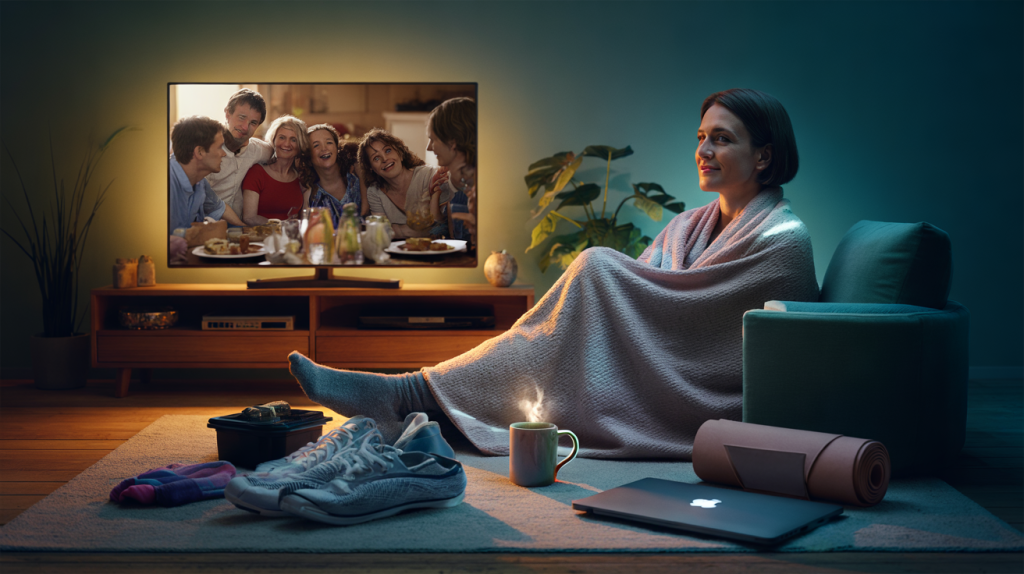
Rewatching Favorites: Comfort That Actually Works
That moment when the day feels too loud and a familiar theme song kicks in – it is not just nostalgia. It is a proven way to steady the mind. In 2020, viewers in the United States streamed 57 billion minutes of “The Office” on Netflix, according to Nielsen. So yes, rewatching is mainstream, not a guilty secret.
Psychologists have mapped why this habit helps. Experiments published in 2012 in Social Psychological and Personality Science showed that revisiting beloved episodes after a tough task restored self-control, improving performance on the next challenge. Earlier work in 2009 in the Journal of Experimental Social Psychology found that favorite shows can substitute for social connection when people feel left out.
The Case For Rewatching: Less Friction, More Focus
Modern viewing is a maze. Nielsen’s “State of Play” report in 2022 counted 817,000 unique program titles available to viewers – choice overload in numbers. That flood increases decision fatigue, which chips away at attention.
With a familiar movie or series, the brain skips the orientation step. No plot anxiety, no new characters to track. The result is cognitive ease, a small but reliable stress release that many feel right away. This is where the AIDA dynamic kicks in naturally: attention returns, interest grows, and motivation to keep going resurfaces.
There is also the belonging effect. In controlled studies, Jaye L. Derrick, Shira Gabriel and Kurt Hugenberg observed that favorite TV provided a sense of social warmth after exclusion. Rewatching acts like a social surrogate, particularly when plans fall through or the room is too quiet.
What Science Says: Nostalgia, Willpower and Mood
The self-control angle matters for everyday life. The 2012 work in Social Psychological and Personality Science tested exactly that dynamic: after tasks that drained willpower, people who revisited a cherished show bounced back better than those who watched something unfamiliar.
Nostalgia adds another layer. A 2013 review in Social and Personality Psychology Compass led by Constantine Sedikides and Tim Wildschut synthesized multiple experiments showing that nostalgia increases positive affect, social connectedness and a sense of meaning. Not a fluffy feeling – a measurable resource.
Time matters too. The Bureau of Labor Statistics reports that Americans spend roughly 2.8 hours per day watching TV on average in 2022. Framing a slice of that time as intentional comfort viewing can be benefical, especially before tasks that demand focus or after days that emptied the tank.
When Rewatching Helps – And How To Use It Without Numbing Out
Comfort can easily drift into autopilot. Two signals to watch: rewatching that delays sleep far past fatigue, and rewatching that crowds out connection or exercise. Both are solvable with small adjustments.
Think of rewatching as active recovery with light structure. Predictable stories lower anxiety and stabilize mood. Then the next step is what to do with the calmer attention that follows – tackle emails, call a friend, read five pages, prep a lunch box.
Here are practical ways to make rewatching work harder for well-being :
- Pick a go-to comfort show for tough days and limit it to one arc or one film.
- Pair it with a routine that serves you : stretching, tidying one drawer, prepping tomorrow’s outfit.
- Use reruns as a reset between tasks – 15 to 25 minutes – then switch devices or rooms to break the scroll.
- Choose episodes that signal competence or kindness when confidence dipped during the day.
- Reserve new, complex shows for weekends when energy is higher and attention can stretch.
Why this works in plain terms : predictability eases threat scanning, familiar characters cue belonging, and the brain conserves energy for what comes next. That is the connective tissue across the findings from 2009 and 2012, and the 2013 nostalgia review.
One more real-world nudge. The data showing 57 billion minutes with a single comfort title proves people default to the known under stress. Using that reflex with intention – a short, chosen rewatch as a bridge to the next task – turns a habit into a tool. It is not about chasing novelty. It is about recovering enough calm to do the next right thing.
Sources : Nielsen, 2020 Streaming Unwrapped ; Social Psychological and Personality Science, 2012 ; Journal of Experimental Social Psychology, 2009 ; Social and Personality Psychology Compass, 2013 ; Nielsen State of Play, 2022 ; Bureau of Labor Statistics, American Time Use Survey 2022.