
U.S. airplane dress code explained: the rules that actually matter
There is no federal dress code for passengers in the United States. TSA handles screening, FAA governs safety, but clothing rules live with airlines. Carriers write them into Contracts of Carriage and gate agents apply them at boarding.
The common thread is simple and surprisingly strict in the small print : airlines reserve the right to refuse transport for bare feet or attire considered lewd, obscene, or offensive. Crew decisions carry legal weight under 49 U.S.C. § 44902(b), which lets airlines deny transport if they believe safety or order could be affected. That is why a T‑shirt can become a ticket problem minutes before the door closes.
TSA, FAA and airlines: who decides what you can wear on a flight
TSA does not impose a dress code at checkpoints. For screening, shoes may need to come off unless enrolled in TSA PreCheck, and children 12 and under can keep them on. After that, clothing becomes an airline call, not a federal one.
FAA rules focus on safety and crew authority, not fashion. The agency’s unruly passenger data shows how seriously crews take compliance: in 2021, FAA recorded 5,981 unruly passenger reports, with 72 percent tied to mask disputes. Different issue, same principle : if attire appears likely to provoke conflict or interfere with crew duties, staff can step in.
Airline policies spell it out. United, American, Delta, Alaska, Southwest and JetBlue all reference versions of bare feet bans and restrictions on attire deemed lewd or patently offensive in their Contracts of Carriage. Wordings vary, but the trigger points repeat across carriers, and the gate agent decides in the moment.
Real cases since 2017: leggings, bralettes and what they taught travelers
On March 26, 2017, a United flight from Denver drew global attention when two teenage pass riders wearing leggings were denied boarding under the airline’s stricter employee and pass travel dress rules. Regular-paying customers were not subject to that internal code, yet the episode showed how fast dress decisions can snowball.
June 30, 2019, physician Tisha Rowe said she was asked to cover up before an American Airlines flight from Kingston to Miami due to a one-piece romper. The airline later apologized. A year later, in October 2020, Southwest delayed passenger Kayla Eubanks in Denver over a bralette-style top; she eventually flew after putting on a T‑shirt. Different airlines, same flashpoint : the line between “casual” and “offensive” is subjective and can shift gate to gate.
The legal backstop still applies. U.S. law bars carriers from discriminating on race, color, national origin, religion, sex or ancestry, and disability protections apply under the Air Carrier Access Act. That means religious head coverings or culturally specific attire cannot be targeted, while crew can act on conduct or narrow attire rules like bare feet and obscenity.
What to wear on a U.S. flight: practical checklist to avoid a denied boarding
Most travelers want zero drama at the jet bridge. A few simple choices reduce the odds of a last‑minute standoff and keep comfort high from security to seat 22A.
- Wear shoes you can keep on after screening : sneakers or flats. Bare feet trigger refusals across airlines.
- Choose layers that look like streetwear, not swimwear : T‑shirt, hoodie, joggers or jeans. Athleisure is fine when it covers well.
- Avoid clothing with explicit imagery or profanity : crews flag “obscene” or “patently offensive” prints first.
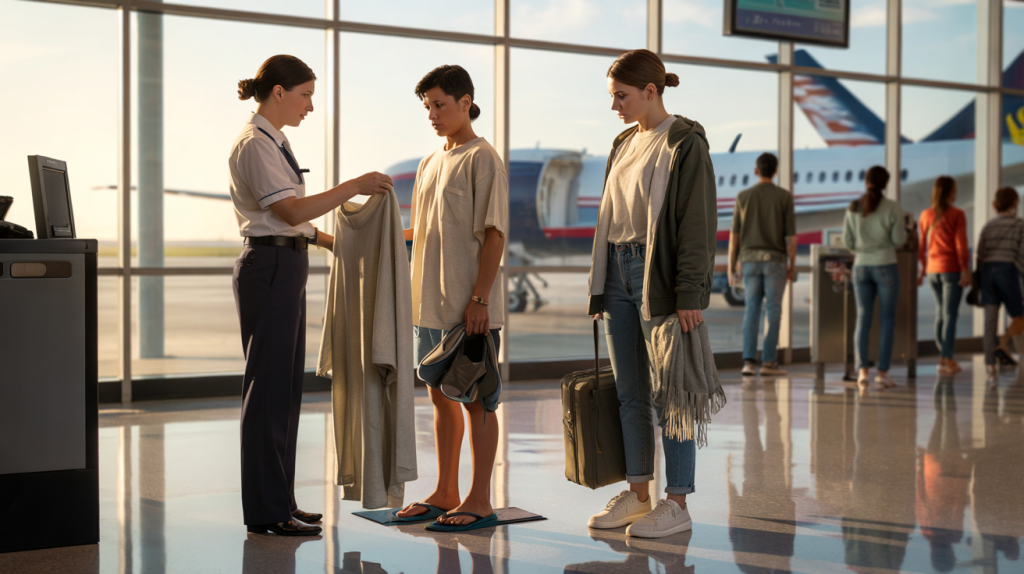
- Pack a light cover item in the cabin : a scarf, cardigan or spare T‑shirt can resolve a gate dispute in seconds.
- Keep accessories practical for TSA : minimal metal, easy‑off watch, belt in the bag if not in PreCheck.
- If flying on a buddy pass or employee pass : follow that program’s stricter dress rules, which often require more formal attire.
One more thing that sounds obvious yet saves time : present clean, intact clothing. Torn garments that reveal too much or outfits that resemble swimwear get the fastest pushback. If a crew member raises a concern, a calm yes and a quick layer fix usually gets everyone moving.
What closes the loop is clarity. Contracts of Carriage give airlines discretion and list the tripwires, but they do not catalog every outfit. That gap creates uneven calls at the gate. Until carriers publish clearer examples, the safest play is a flexible outfit and a ready layer. It is not about dressing up. It is about removing reasons for a gate agent to hesitate and, definitly, making the flight.