
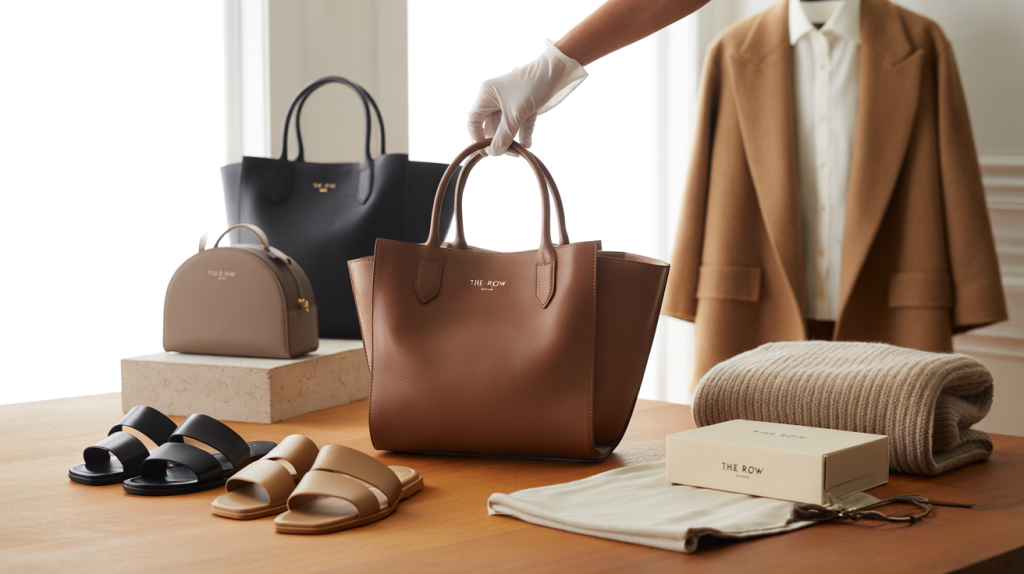
Buying The Row and want your money back later? See which pieces keep value, real data behind demand, and how to list for the best possible price.
The Row’s resale value has become a hot question as quiet luxury goes mainstream and the Margaux bag turns into a status signal you have to look closely to notice. For shoppers debating a four-figure purchase, the key is simple : some pieces hold remarkably well, others sink fast. The gap comes down to model, color, condition, and timing.
Context matters. The Row, founded in 2006 by Mary-Kate Olsen and Ashley Olsen, sits at the center of the quiet luxury wave. Lyst’s Q2 2023 Index tracked a 614% jump in searches for “quiet luxury”, a shift that pushed logo-free staples into the spotlight. In parallel, the personal luxury goods market reached €362 billion in 2023 according to the Bain et Altagamma study, and the U.S. secondhand apparel market is projected to hit roughly $70 billion by 2027 per the thredUP 2023 Resale Report. Demand is there – value depends on what you buy and how you sell.
The Row resale value, in practice
Main idea first. The Row retains the most value in structured leather bags, core sandals, and signature knits that return every season. Buyers pay for longevity, not novelty. Clean lines, premium materials, and minimal hardware help pre-owned prices stay stable because they age well and blend with wardrobes.
Observation from the market is clear. When a piece achieves “uniform” status – think a tote carried daily by editors – liquidity improves. Lyst’s Q3 2023 Index listed The Row Margaux among the hottest products, signaling broad visibility. That visibility fuels search, which fuels sell-through on resale platforms. But runway experiments or ultra-seasonal colors do not ride the same curve.
Problem to solve. Not every The Row buyer wants to be a market timer. Yet price jumps and waitlists can tempt a flip that later disappoints if comps were misread. The challenge is separating genuinely durable icons from momentary hypes – then listing with the right photos and proof to reduce buyer hesitation.
Bags like the Margaux lead – with caveats backed by data
Quiet luxury’s momentum lifted demand for understated totes and top-handles. The Margaux, the Park Tote, and the Half Moon family are frequent search magnets across platforms. Visibility aside, value still hinges on condition grades, dimensions, and core shades like black, chocolate, and natural tan.
A few datapoints frame the landscape. Lyst’s 2023 indices repeatedly highlight quiet luxury and The Row’s breakout accessories, which correlates with increased listing velocity on major resale sites during that period. On the macro side, Bain et Altagamma’s 2023 figure – €362 billion for personal luxury goods – confirms the audience grew while thredUP’s 2023 report points to a secondhand market expanding toward $70 billion in the U.S. by 2027, supporting sustained buyer pools.
Here’s the mistake many make. Assuming any The Row bag behaves like the Margaux. It does not. Soft, unstructured totes without a clear cult following tend to be more price sensitive. Exotic skins narrow the buyer base. Bright seasonal shades slow down offers. And incomplete sets – missing dust bag or reciept – cut value quickly.
Where to sell The Row for the best outcome
Channel choice shapes net proceeds and speed. Consignment platforms with authentication and grading reassure buyers, especially for four-figure bags and pristine footwear. Transparent fees and robust comps beat guesswork.
Large marketplaces attract the widest audience for The Row: curated consignors that photograph and authenticate, and peer-to-peer platforms where you control pricing. Authentication and buyer protection matter at this price bracket, which is why many sellers test a slightly higher list price on managed platforms before moving to peer-to-peer if it lingers.
Timing helps. List right before seasonal peaks – early spring for sandals, early fall for outerwear and heavy knits. New model drops or editorial moments can lift searches for a few weeks. Track live comps, not asking prices, then price within the sold range to reduce time-to-sale.
How to protect value : models, colors, and listing tactics
If the goal is resilience, shop like a future seller. Focus on permanent line pieces in neutral palettes, and keep the full set intact.
- Bags with steady demand : Margaux family, Park Tote, Half Moon styles in black, chocolate, taupe
- Shoes that resell : Bare sandals, Ginza sandals, leather loafers in core colors
- Wardrobe classics : heavy cashmere knits, tailored coats, crisp shirting without visible logos
- Skip for value retention : niche runway items, flashy seasonal hues, fragile suede for daily wear
Photography is your leverage. Shoot in daylight, include scale references, and capture edges, corners, handles, and interiors. Then upload the full set – dust bag, tags, original packaging, and a clear proof of purchase. Those details compress negotiation and reduce returns.
Logical view on pricing. Start near the median of recent sold comps for matching size, leather, and condition. If interest stalls in 10 to 14 days, adjust in small steps rather than a single large cut. Cross-listing can expand reach, but pause one listing when you accept an offer elsewhere to avoid conflicts.
One last piece that often unlocks the sale : standardized measurements. The Row names – 15, 17, 21 – can confuse new buyers. Add exact dimensions in centimeters and inches, plus drop lengths and weight. Clarity beats description flair and gets the item out the door at the number you want.