
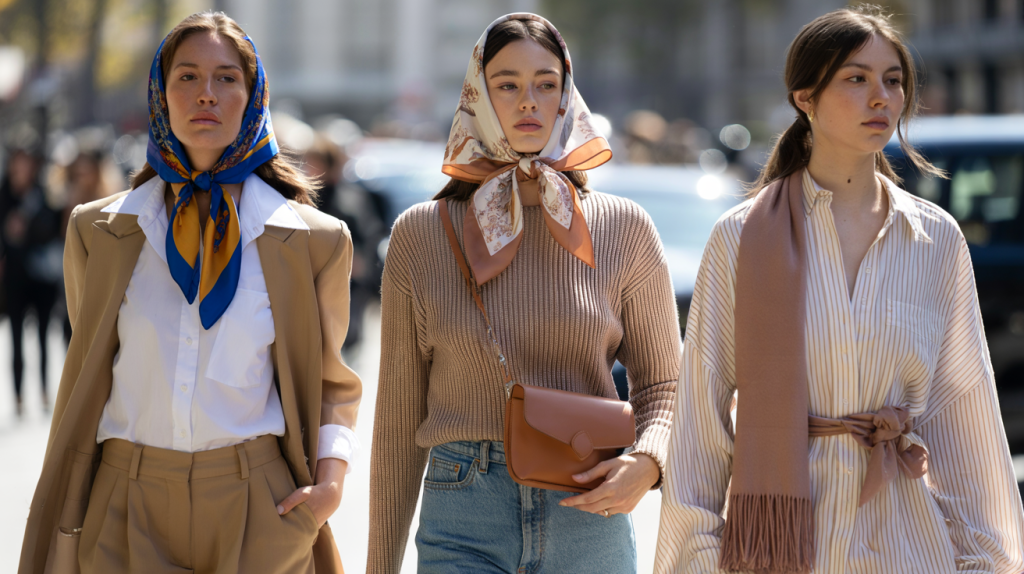
Scarf fever strikes again this season, and for good reason. One square of fabric can flip a basic outfit into a headline look, adapt to weather mood swings, and travel light in a tote. The best part : it works on every budget and every style, from minimal to coloful maximal.
Here is what matters right now. Small neckerchiefs sharpen tees and blazers, silky headscarves frame the face with an old-film glow, long wraps soften sharp coats, and a scarf as a belt or bag handle adds an instant lift. The idea is simple : one piece, many lives, zero fuss.
Scarf outfit ideas this season : what works now
The main move this season is versatility. Dress codes shifted, commutes change, and weather flips within hours. A scarf bridges those gaps. Tie a compact square at the neck in the morning, retie as a headband by noon, drape it on shoulders for the evening chill. It reads intentional, not over-planned.
One more reason the scarf keeps returning : cultural durability. The iconic square entered modern closets in 1937, when Hermès introduced its printed silk format according to the brand’s archives. That heritage gives a classic base while prints and fabrics evolve.
When pairing, think textures that talk to each other. Crisp poplin shirt with matte cotton scarf, ribbed knit with soft cashmere, structured blazer with lustrous silk. Size guides the vibe. A 50 to 70 centimeter square pulls neat neck or wrist ties. Larger squares and oblongs invite draping or headwraps.
How to style a scarf : from headscarf to belt
Start with one scarf and rotate techniques across the week. It maximizes wear and keeps the look fresh without new buys. Quick ideas below.
- The neck pop : fold a small square into a band, tie off-center with the tip pointing down.
- The headscarf : triangle fold, knot at the nape, hair tucked or loose for a retro finish.
- The belt swap : thread a long scarf through jeans loops, tie a short knot on the hip.
- The bag handle wrap : spiral around the top handle, knot underneath to hide the ends.
- The cuff trick : wrap a narrow band twice around the wrist, tiny knot facing inside.
- The shoulder drape : let a long scarf fall front and back, secure with a slim brooch.
- The ponytail ribbon : tie at the base of a low pony, ends left long.
- The turtleneck layer : tuck a silk square inside a knit collar, corner peeking out.
- The waist sash over dresses : cinch a shirt dress with a wide scarf for shape and print.
- The collar lift : slide a small triangle under a shirt collar, knot hidden between buttons.
- The cape tuck : spread a large square over shoulders, belt at the waist to hold.
- The hood-scarf combo : light wool scarf under a coat hood, framing the face neatly.
- The blanket wrap for travel : oversized scarf as a plane wrap, then folded as a pillow.
- The tonal stack : same color family as the coat, one shade lighter for depth.
Fabrics, sizes and care : choosing a scarf that lasts
Fabric decides mood and function. Silk adds glow and slides easily for polished knots. Merino and cashmere bring warmth without bulk. Cotton and linen feel breathable and casual, perfect between seasons. Synthetic options can mimic silk’s drape, yet they shed microfibers during washing. The International Union for Conservation of Nature reported in 2017 that 35 percent of primary microplastics in the oceans originate from synthetic textiles.
For sun-friendly looks, UPF ratings help. The Skin Cancer Foundation states that UPF 50 fabric blocks 98 percent of UV rays. That matters for headscarves at midday or long days outdoors. Look for breathable weaves in light colors when heat rises.
Sizing keeps styling flexible. A compact 50 to 70 centimeter square handles neck, wrist and hair ties. A classic large square sits roughly around 90 centimeters. Long rectangles work for belts, big bows and blanket drapes. If storage is tight, pick one large square and one slim rectangle, both in colors that echo your coat or favorite knit.
Sustainable scarf choices : data, sources and smart shopping
Longevity beats novelty. Re-wearing a scarf reduces fashion waste, and the Ellen MacArthur Foundation highlighted in 2017 that the equivalent of one garbage truck of textiles is landfilled or burned every second. That is a nudge toward quality pieces and circular options.
Two practical routes. First, natural fibers from responsible labels, with clear origin and care instructions. Second, secondhand and vintage, where scarves are standouts in great condition. Vintage silks often hold color better, and prints stay unique in a sea of basics.
Care seals the deal. Hand wash silk in cool water with a gentle, pH-neutral detergent, press in a towel, then air dry flat away from direct heat. Store folded, not hanging, to prevent bias stretching. For wool, use a dedicated wool wash and reshape while damp. Small steps, long life.
The missing piece for many outfits is not another jacket or a new dress. It is one smart scarf that moves with the day. Start with a color that sparks joy next to your coat, learn two knots, then add a print that speaks to you. The season will do the rest.