
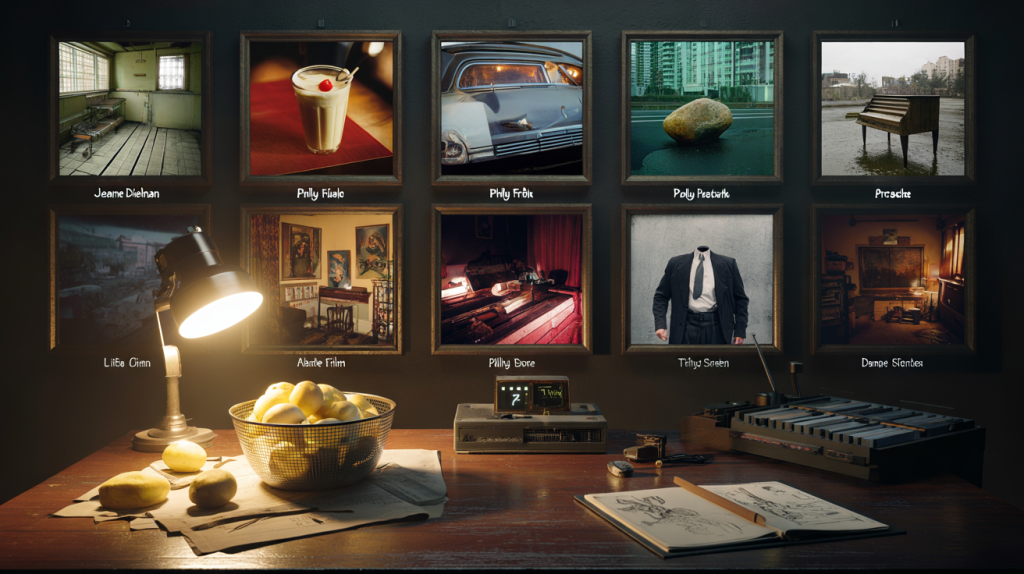
Some films change how movies feel, look, and speak. They bend the rules, put a director’s signature front and center, and leave viewers with images that keep echoing for years. That is the promise of films d’auteur, and yes, the list below delivers straight away.
This guide brings the most cited auteur landmarks together, with the hard facts that count: festival wins, Academy Awards, and respected polls. Names from Cannes to BFI Sight and Sound anchor the choices, so you know why each title matters now, not just in the past.
What makes a great film d’auteur today
Auteur cinema puts the director’s voice first. Style, recurring themes, and a precise way of framing life drive the film more than formula or franchise logic. You feel authorship in the cut, the color, the silence.
That approach is not niche. It travels. Major wins at Cannes, Venice, and the Oscars prove that singular vision attracts global audiences and critics, decade after decade.
Top 10 films d’auteur to watch now
Looking for a focused shortlist, not an endless canon debate. Start here, where acclaim and influence meet, with awards and dates from official sources.
- “Jeanne Dielman, 23, quai du Commerce, 1080 Bruxelles” by Chantal Akerman, 1975. Ranked number 1 in the 2022 critics poll by BFI Sight and Sound (BFI).
- “Pulp Fiction” by Quentin Tarantino, 1994. Palme d’Or winner 1994, official Cannes record (Festival de Cannes).
- “Parasite” by Bong Joon Ho, 2019. Palme d’Or 2019 and four Oscars at the 92nd Academy Awards, including Best Picture, a first for a non English language film (Cannes, Academy of Motion Picture Arts and Sciences).
- “The Piano” by Jane Campion, 1993. Palme d’Or 1993 and three Oscars in 1994, including Best Actress and Best Supporting Actress (Cannes, AMPAS).
- “8½” by Federico Fellini, 1963. Two Oscars at the 36th Academy Awards, including Best Foreign Language Film (AMPAS).
- “Rashomon” by Akira Kurosawa, 1950. Golden Lion 1951 and an Honorary Academy Award in 1952 for foreign language achievement (La Biennale di Venezia, AMPAS).
- “Tokyo Story” by Yasujirō Ozu, 1953. Number 1 in the 2012 directors poll by BFI Sight and Sound (BFI).
- “The 400 Blows” by François Truffaut, 1959. Best Director at Cannes 1959 (Festival de Cannes).
- “In the Mood for Love” by Wong Kar wai, 2000. Best Actor for Tony Leung Chiu wai at Cannes 2000 (Festival de Cannes).
- “2001: A Space Odyssey” by Stanley Kubrick, 1968. Oscar for Visual Effects in 1969 and selection to the National Film Registry in 1991 (AMPAS, Library of Congress).
Awards and facts that seal the legend
Polls matter when they are broad and transparent. The 2022 BFI Sight and Sound critics survey, which placed “Jeanne Dielman” at the summit, consulted 1,639 critics and programmers worldwide, a scale that reshaped consensus with data, not vibes (BFI).
Festivals have been the launchpad. Cannes, founded in 1946, remains the stage where distinctive visions reach the world. The Palme d’Or has marked career turning points from “Pulp Fiction” in 1994 to “Parasite” in 2019, before those films travelled to theaters and awards circuits with momentum that audiences felt immediately (Festival de Cannes). In the preservation world, the Library of Congress National Film Registry adds up to 25 films each year for cultural, historic, or aesthetic significance, a safeguard that placed “2001: A Space Odyssey” in 1991 (Library of Congress).
How to dive into auteur cinema without feeling lost
Set a simple path. Pair one classic with one contemporary each week, and rotate continents. For example, “Rashomon” with “Parasite”, then “The 400 Blows” with “In the Mood for Love”. Read the one page festival note or a short interview before pressing play. Context helps the images land.
Watch on platforms that program director led work, visit your local cinematheque, and keep a tiny log of shots or moments that stay with you. No pressure to decode everything. The aim is attention, not perfection. After two or three titles, patterns surface on their own, and your taste map grows. Feels almost indispensible, right.