
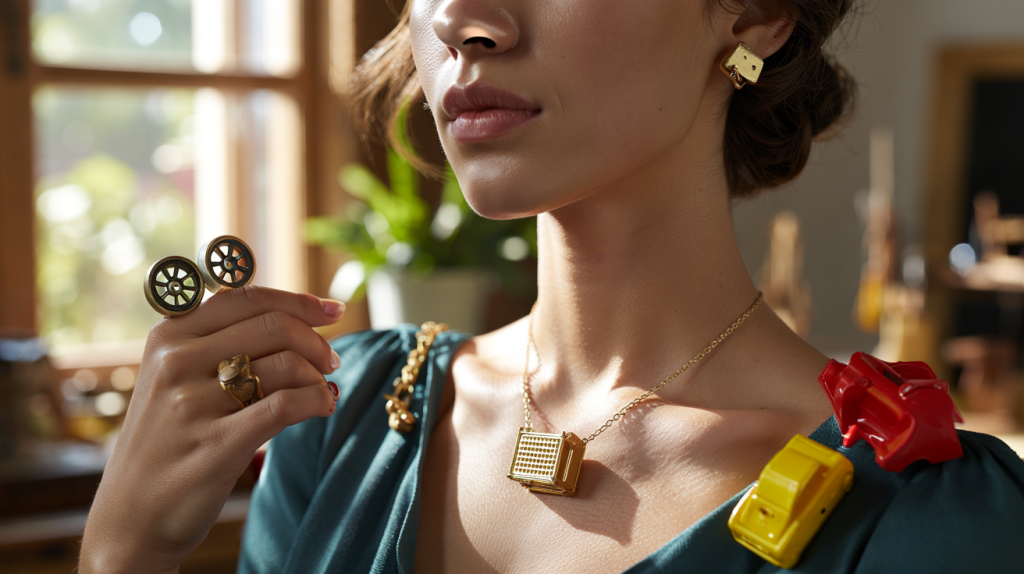
One glance and it hits like a memory. A tiny figurine, a LEGO charm, a Hot Wheels pendant. Childhood toys are turning into head-turning jewelry, and it is not just cute. It is personal, wearable, and surprisingly chic.
The idea is simple and it answers a real need. People want meaningful pieces that do not strain the planet. Only 9 percent of plastic waste was recycled worldwide in 2019, noted the OECD in 2022. And traditional gold mining can generate up to 20 tons of mine waste for a single gold ring, rappelle Earthworks in its No Dirty Gold campaign. Upcycling a toy into a necklace or ring shifts the equation fast, with a story that stays close to the skin.
Nostalgic jewelry that actually fits daily life
The main draw is emotional resonance. A charm cut from a favorite toy signals identity, not a logo. It feels light, fun, and easy to pair with basics. That emotional value also solves a common problem with impulse jewelry purchases that stay in a drawer. When the piece carries a childhood link, it gets worn. Often.
Designers noticed. Small studios and independent makers have turned game tokens, mini dolls, and die-cast cars into pendants and ear studs. Some cast the toy in silver or gold to lock in durability. Others keep the original object, then seal it with a clear, skin-safe resin. The result has range, from playful weekend looks to polished office pieces.
What works best: materials, scale, and safety
Not every toy or part belongs near the skin. Size, weight, and composition matter more than the sentimental rush. Plastics like ABS, found in many building bricks and minifigures, hold shape and color well. Softer plastics or sticky coatings age poorly. Metal parts need a careful check for lead or nickel. If in doubt, ask for testing or choose a cast replica in recycled silver or gold.
There is also comfort. Large toys can be charming on a shelf, yet awkward on a chain. Small details shine in jewelry: a wheel hub, a tiny emblem, a character’s head, a token from a board game. The trick is editing the memory without losing its soul.
Common pitfalls pop up once work starts. Glue alone will not last. Heat can warp plastic. Bare metals may tarnish. The fix is straightforward: proper findings, cold connections where possible, and a sealing coat made for skin contact.
Useful checkpoints before turning a toy into a pendant or ring:
- Choose dense, stable parts that resist scratches and sunlight.
- Test weight and balance on a temporary chain to avoid twisting.
- Pick nickel-free findings and request hypoallergenic posts for earrings.
- Ask for a protective seal or a metal casting if the piece will be worn daily.
Proof in the numbers: waste cut, meaning gained
The sustainability angle is concrete. The OECD’s 2022 review on plastics confirmed the 9 percent global recycling rate for 2019, with most plastic still landfilled or burned (OECD, “Global Plastics Outlook 2022”). Diverting even a small stream of sturdy toys into long-lived accessories slows that flow and extends product life.
Mining’s footprint also puts context around material choices. Earthworks states that producing enough gold for one ring can leave around 20 tons of mine waste, a figure used to highlight the benefits of recycled metals and lower-impact design (Earthworks, “No Dirty Gold”). When a toy becomes a keepsake or when a toy is recast into recycled silver, the environmental cost changes direction.
Beyond ecology, there is social value. An heirloom does not need a gemstone to carry weight. A pendant cut from a childhood token can mark a graduation, a new job, or a birth. Right there, the piece earns a place in daily rotation rather than a vault.
From toy to wearable heirloom: the clear, simple path
The process starts with choosing the right object. Look for pieces in good condition with clean edges and a shape that reads instantly. A small car badge, a brick accessory, a game counter. If doubt creeps in, take photos on the neck or wrist to test visual scale. Quick and revealing.
Next comes the build. A jeweler drills a tiny hole or sets a hidden bail, then fixes the finding with a mechanical link. Resin sealing, if used, stays thin and even, not a bulky dome. For rings, a bezel or cage protects the toy and keeps fingers comfortable. Some projects go one step further and cast the toy in recycled silver or gold. The form survives while the material becomes ready for a lifetime.
Budget depends on complexity and finishes rather than brand prestige. Polishing, plating, stone accents, or hand engraving add cost but also longevity. Good makers deliver a small care card and, when relevant, a note on recycled metals or allergy-safe parts. Simple and reassuring.
Then the final touch. Photos under natural light help confirm proportions. A short backstory printed on the packaging seals the bond. Suddenly, an old toy is not clutter. It is a piece of jewellry with a life ahead, and a past that stays close.