
You searched “trashcore” and landed in a strange split world. On one side, a breakneck hardcore punk microgenre. On the other, a gritty internet aesthetic built from garbage, rust, and ripped tape. Same word in the wild, two very different meanings.
Here is the point: trashcore often means thrashcore in music circles, a hyper-fast branch of hardcore born in the early 1980s. Outside music, trashcore also labels a visual style that romanticizes waste and urban grit across Tumblr and TikTok. Sorting that out helps you find the right tracks, the right visuals, and avoid the classic confusion.
What Trashcore Really Means Today: Music Term vs Aesthetic
In music contexts, trashcore typically refers to thrashcore, also known as fastcore. It is the speed-obsessed edge of hardcore punk, where songs blast by in seconds and the energy barely touches the ground.
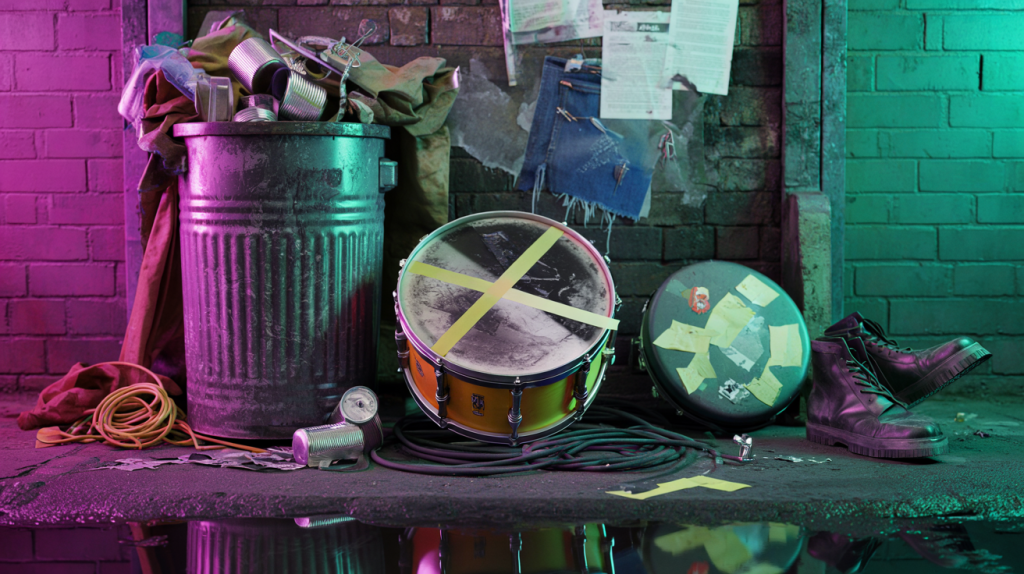
Online, the trashcore aesthetic points to images of overflowing bins, duct tape, crushed cans, ripped clothes, parking-lot oil slicks, and neon grime. Think lo-fi snapshots, disposable cameras, and a taste for the thrown-away. The two meanings overlap in attitude, not in format.
Thrashcore, The Fast Hardcore Sound: Origins, Bands, Dates
Thrashcore emerged in the United States in the early 1980s within hardcore scenes that wanted everything faster and shorter. AllMusic’s overview of thrashcore identifies the hallmark traits clearly: blistering tempos and songs that can clock in under one minute. Source : AllMusic.
Numbers tell the story. D.R.I.’s “Dirty Rotten LP” bundled 22 tracks into roughly 18 minutes in 1983. Source : Wikipedia. Siege recorded the “Drop Dead” sessions in 1984 in Massachusetts and pushed speed to extremes that nudged grindcore’s birth. Source : Wikipedia.
The scene spread quickly. In the United Kingdom, Heresy operated from the mid to late 1980s and is frequently cited in scene histories for accelerating the form. Source : Wikipedia. The 1990s kept the pace with bands that embraced the label fastcore, including Charles Bronson, active from 1994 to 1997. Source : Wikipedia.
For scale on micro-songs, punk’s speed wars peaked in adjacent genres too. Napalm Death released “You Suffer” in 1987 at 1.316 seconds. Different style, same arms race for brevity. Source : Wikipedia.
Trashcore Aesthetic Online: Visual Codes, Influences, Examples
Outside the pit, trashcore became a visual language. It curates decay with intent: cracked plastic, torn flyers, grimy tiles, flickering streetlights, boot scuffs on concrete. The mood is dirty, but styled. A little dangerous. Often DIY.
This aesthetic grew across photo-sharing platforms in the 2010s and keeps cycling through TikTok edits and moodboards. The links to punk make sense. Zines, photocopiers, and tape culture already valued roughness. Trashcore just centers the waste itself and treats it as texture.
Photography drives it. People shoot sidewalks at night, supermarket backrooms, alleys after closing. Clothes follow suit: ripped denim, safety pins, patched jackets, work gloves. It feels lived-in and throwaway at the same time, which is exactly the point.
How to Spot the Difference and Go Deeper
Two uses of one word can be a headache when searching. A quick test helps: are you hearing sound or seeing images. If it is about BPM, song length, or bands, you are in thrashcore territory. If you land on moodboards and landfill textures, that is the trashcore aesthetic.
Here is a simple cheat sheet you can keep:
- Thrashcore : early 1980s hardcore offshoot, extremely fast songs, often under one minute, bands like D.R.I., Siege, Heresy. Sources : AllMusic, Wikipedia.
- Trashcore aesthetic : visual style of waste and urban grime, DIY photography, ripped fabrics, tape, alleyways, late-night neon, shared via social platforms.
Want to explore the music. Start with D.R.I.’s “Dirty Rotten LP” from 1983 for a measured entry point that still sprints. Follow with Siege’s 1984 recordings for the outer edge. Then sample 1990s fastcore like Charles Bronson to hear how the blueprint evolved.
Curious about the aesthetic. Build a small photo set: a dented can against a painted curb, torn poster layers, a taped-up backpack strap. The goal is texture and mood, not mess for its own sake. One last note on spelling : the music style is usually written thrashcore or fastcore. People type trashcore by mistake all the time. That definiton drift created the split.