
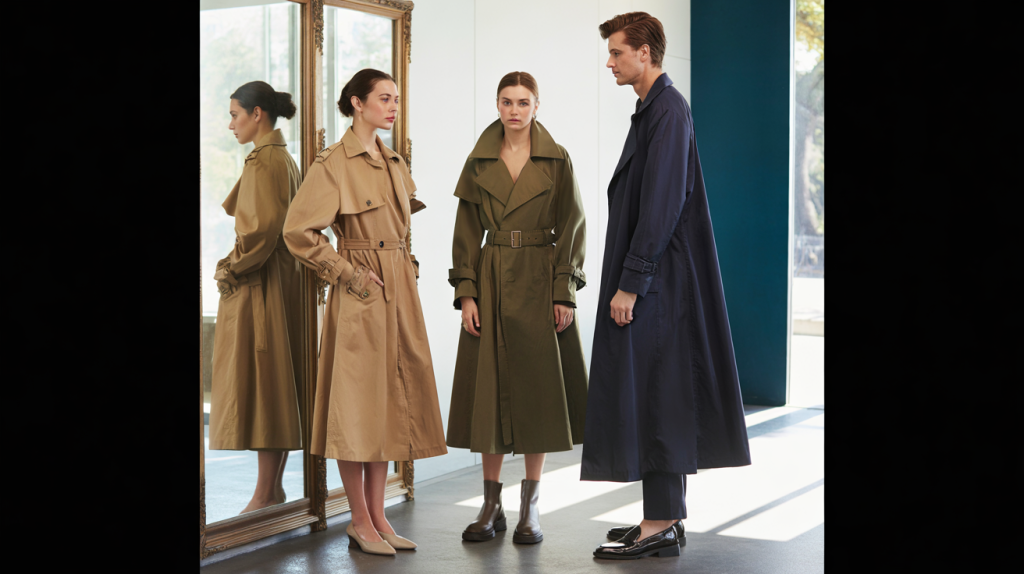
Knee, mid calf or ankle : discover the exact trench-coat length that flatters your height, shoes and routine, with brand sizing decoded and pro fit rules.
Staring at a mirror and hesitating between knee, mid calf or ankle length happens to almost everyone. The right trench-coat length depends on height, leg proportions, footwear and where the coat will live day to day. A practical rule lands fast : place the hem just above or just below the fullest part of the calf, never on it, so the leg line looks longer and the silhouette stays clean.
Most brands sell three length families, which helps the decision. On many bodies the sweet spot sits around the knee to mid calf, then shifts with heels or chunky shoes. For context, the average adult height in the United States is about 161.9 cm for women and 175.4 cm for men according to the Centers for Disease Control and Prevention, National Center for Health Statistics, in 2021, using 2015 to 2018 data. That baseline explains why mid options work for a majority, while petites often benefit from a slightly higher hem and taller figures carry extra length with ease.
How to choose your trench-coat length fast
Start with the shoes. Flats and thick soles visually shorten the lower leg, heels extend it. Then look at volume : a wide A-line can handle a touch longer, a straight cut looks sharper when the hem clears the calf’s widest point by a few centimeters.
Mirror test in two steps : sit, then stand. Sitting shows if the coat bunches at the knee, standing confirms the vertical line. If the fabric pools on your boots or chops the shin in half, shift the hem a little higher or lower.
Brands make this easier with clear buckets. Burberry, for instance, labels its heritage trench coats in short, mid and long, visible on current product pages and size guidance, accessed 2025. Short tends to hover above the knee, mid near the knee, long reaches well into the calf. That naming lets a buyer filter quickly before fine tuning.
Quick mapping for everyday choices that many stylists use :
- Under 162 cm or wearing flats : knee length or a hair above the knee to elongate the leg line.
- 162 to 170 cm : knee to upper mid calf, especially if the coat is straight or belted.
- 170 cm and taller : mid calf reads balanced, ankle grazing if the cut is fluid and the shoe has some height.
- Heels of 5 cm or more : you can drop the hem a notch without shrinking the leg visually.
Body proportions, heels and the 61.8 percent trick
Not all heights carry length the same. If legs are proportionally shorter than the torso, aim higher at the knee to avoid compressing the lower leg. If legs are longer, mid calf looks refined and never stumpy.
Design schools often reference the golden ratio : roughly 61.8 percent. Used as a visual guide, placing the coat’s hem so that the longer visible leg segment takes about 61.8 percent of the overall leg length usually feels harmonious. It is a design heuristic, not a law, documented widely in design literature such as Mario Livio’s 2002 book “The Golden Ratio”. Try it as a starting point, then trust the mirror.
Shoe choice changes everything. A chunky Chelsea boot or sneaker shortens the look of the shin, so nudging the hem a few centimeters higher keeps the silhouette light. A slim heel or heeled loafer adds verticality and lets the hem travel lower without visual weight.
What brands mean by short, mid and long trench coats
Short, mid and long are not universal measurements, they are families. Within each, exact centimeters shift by size and fit. Heritage labels like Burberry present these three options on core styles, which helps align expectations before trying on. Mid generally lands around the knee on an average-height wearer, long enters the calf, short clears the knee.
When shopping online, look for the back length in centimeters on the size chart, then compare to a coat you already own. Measure from the back neck point to the hem, flat on a table, to avoid curved tape errors. That single check prevents returns and lets a tailor know how many centimeters to raise or drop.
Fabric matters too. Heavier cotton gabardine hangs straighter and reads longer to the eye, even at the same measured length, while a drapey twill can acccomodate an extra centimeter or two without feeling heavy.
Try-on checklist, tailoring and real life use
Test movement. Walk, climb a stair, sit at a café chair. If the hem drags on the back of your calf or sticks to boots, it is likely too long for daily life, even if it looked elegant still.
Check layers. With a blazer underneath, the body length seems shorter relative to your leg. That is why many office wardrobes lean to knee or upper mid calf. For weekend denim and a slim knit, a longer hem adds drama without bulk.
Tailors can adjust most trench hems cleanly if there is no deep back vent cutting into the alteration line. Ask to pin the hem 1 to 2 cm above your target while standing in your usual shoes, since fabrics settle after a few wears. Keep the belt tie height at your natural waist, not dropped on the hip, so the skirt below the belt reads intentional rather than accidental.
A last check against the mirror : the eye should travel smoothly from shoulder to hem to shoe, with no awkward break at the widest calf point. When that line flows, the length is right, no matter the label’s name. The mirror tells the truth, then the street confirms it across a week of real commutes and weather. According to the CDC report cited earlier in 2021, most adults cluster near those average heights, which explains why these length zones work consistently across sizes and wardrobes.
Sources : Centers for Disease Control and Prevention, National Center for Health Statistics, “Anthropometric Reference Data for Children and Adults : United States, 2015–2018”, December 2021. Burberry product pages and size guide, accessed 2025. Mario Livio, “The Golden Ratio”, 2002.