
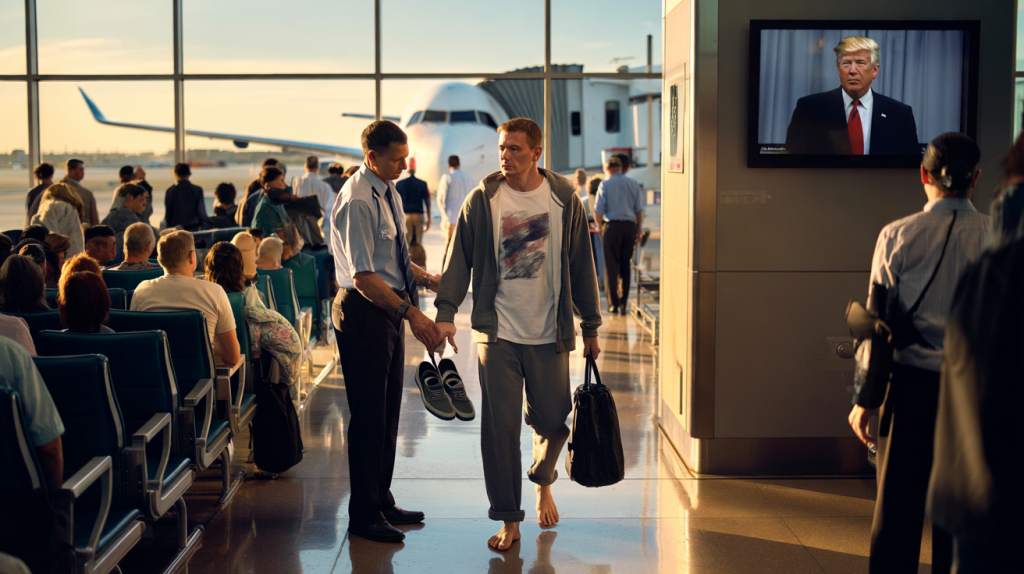
Did Donald Trump push a dress code for airline passengers?
Social feeds lit up: “Trump wants a dress code for airplane passengers.” The claim taps into a tense moment for air travel, where viral cabin dust-ups and full flights already set nerves on edge.
Airlines do turn people away for clothing disputes, and federal authorities track unruly behavior in the sky. So the idea of a national dress rule sounds plausible at first glance. But plausibility and policy are two different lanes.
Here is the clearest point: as of October 2024, there is no federal dress code for airline passengers in the United States, and there is no publicly announced proposal by Donald Trump or federal regulators to create one. Passenger attire remains governed by airline contracts of carriage and general safety or decency standards, not by a nationwide rule.
What U.S. law and airline policies actually say on passenger attire
Federal law sets safety and security requirements for aviation, not fashion. Transportation Security Administration screening rules focus on prohibited items and identity verification. The Federal Aviation Administration enforces safety and unruly passenger regulations. None of these create a clothing mandate for passengers.
Dress rules live in airline contracts. Major U.S. carriers reserve the right to deny boarding for bare feet, obscene or lewd attire, clothing with profane or overtly offensive wording, or anything that could reasonably cause a disturbance. Crew calls are case by case and must be tied to safety, operational, or customer comfort standards spelled out by each airline.
Controversies happen, and they are not new. In March 2017, a high profile case involving “pass travelers” on United Airlines triggered a global debate about leggings and airline standards. Other disputes have popped up over slogans on shirts or outfits seen as too revealing. The details differ by flight and carrier policy, but the throughline is consistent: the decision stems from the airline’s published conditions, not a federal dress code.
Why the rumor travels : FAA numbers, packed flights, and in-flight tensions
Stress in the system fuels rumor cycles. The FAA logged a historic surge in unruly passenger reports in 2021: 5,981 cases, much of it tied to the mask mandate that year, with hundreds of formal enforcement actions launched. In 2022, reports fell to 2,455 as pandemic rules eased, still far above pre-2020 norms, according to FAA data.
Crowding adds friction. On November 26, 2023, the TSA screened about 2.9 million travelers in a single day, a record since the agency was created after 9-11. When cabins are this full, small conflicts escalate faster, and dress flare-ups can become flashpoints that ricochet online.
Political noise completes the mix. The U.S. Senate dress debate in 2023 kept attire in the headlines, even though it had nothing to do with aviation. Linking that energy to airlines feels natural on social networks, but policy-wise, it is a different story. Aviation rules flow through the Department of Transportation, FAA, and TSA. Airline attire remains an airline call.
Practical checklist to avoid dress code trouble when flying
Most travelers want a simple path to yes at the gate. The good news: avoiding attire disputes is straightforward, and it starts with the policies already on the books.
- Check your airline’s contract of carriage the week you fly, then pack one neutral layer to cover graphics or skin if asked.
- Avoid clothing with profanity, explicit imagery, or confrontational slogans that could reasonably cause complaints.
- Wear shoes during boarding. Bare feet are commonly barred and can trigger denial of boarding.
- If a crew member raises a concern, de-escalate and ask for the specific policy language. Calm, quick fixes usually keep you on the flight.
There is also the legal frame. Flight crews must be able to maintain order and safety. FAA rules allow crew instructions to be enforced – disobeying can lead to removal and civil penalties. That is why seemingly subjective attire disputes occasionally cross into enforcement. It is not about style, it is about whether the situation risks disrupting the operation.
So where does that leave the Trump rumor. As of late 2024, no federal move exists to impose a national dress code on airline passengers, and none has been formally proposed by Donald Trump. If a future administration or Congress wanted to try, it would face a thicket of First Amendment and commercial practice questions, and airline contracts already cover the narrow, operational needs.
The missing piece for most travellers is clarity at booking. Airlines could surface plain language on attire in the purchase flow – not legalese buried in a PDF – and cut down on surprises at the jet bridge. Until then, knowing the house rules, traveling with a backup layer, and keeping interactions calm solves 99 percent of what becomes a headline. Occassionally, that spare hoodie is the real travel insurance.