
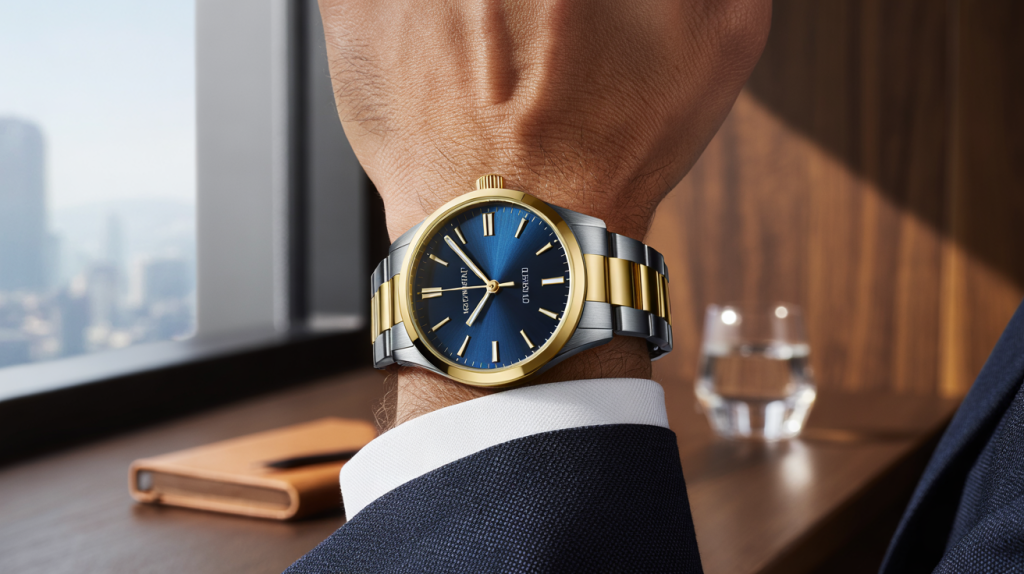
Two-tone is back on the wrist, and not in a quiet way. Mixing steel and gold gives a luxe edge without going full precious metal, which explains why the montre bicolore homme luxe sits at the sweet spot between elegance and daily wear. This blend reads smart at the office, confident at dinner, and it does not scream for attention.
The timing aligns with the broader watch boom. Swiss watch exports reached CHF 26.7 billion in 2023, a 7.6 percent rise year on year, driven by higher value pieces and strong brand leaders (Federation of the Swiss Watch Industry FH, 30 January 2024). Rolex alone captured about 30.3 percent market share by value in 2023, according to Morgan Stanley with LuxeConsult, reinforcing classic steel and gold icons as safe bets for many buyers (March 2024). Yes, the data backs the feeling in boutiques.
Why two-tone luxury makes sense right now
Gold set fresh records in 2024, touching above 2,400 US dollars per ounce in April, which nudged many toward steel and gold watches that deliver warmth without full-gold prices (World Gold Council, April 2024). That budget logic blends with design: the contrast between brushed steel and polished gold catches light in a way a single metal cannot.
There is also wardrobe agility. A two-tone bezel or bracelet pairs with navy suits, casual shirts, even a smooth leather jacket. One watch, multiple contexts. For wrists that want presence but not bulk, a 36 to 41 mm case in steel and gold often lands just right.
On the pre-owned side, momentum remains clear. Deloitte estimated the secondary market at roughly 20 billion US dollars in 2022 and projected up to 35 billion by 2030, a path that supports liquidity for timeless references in steel and gold (Deloitte Swiss Watch Industry Study 2023). Stronger resale usually follows recognisable designs and steady demand.
Iconic two-tone models : Rolex, Omega, Cartier, Tudor
Rolex “Rolesor” sets the benchmark. The Datejust in 36 or 41 mm and the Submariner date in steel and yellow gold are the clasical templates. Clean dials, solid bracelets and movements known to run for decades make them frequent first choices.
Omega brings a sport-luxe angle with the Seamaster Diver 300M in steel and Sedna Gold. The laser-engraved wave dial keeps things modern while the ceramic bezel resists scratches on daily duty.
Cartier leans elegant with the Santos in steel and gold. Square case, visible screws, quick-switch straps, and a bracelet that glints without going flashy. For a dressier line, the Tank in two-tone remains discreet yet instantly recognisable.
Tudor targets value with the Black Bay S and G family. The mix of steel and yellow gold on a rivet-style bracelet delivers vintage charm and COSC-certified movements at prices below many rivals from the same group.
How to choose a two-tone watch that suits your wrist
Start with the problem most buyers face : balancing sparkle and understatement. The goal is harmony, not excess. A brushed steel bracelet with polished gold center links reads subtler than full polish.
Common mistakes include picking the wrong size for the wrist, choosing ultra-shiny bracelets that mark easily, or chasing limited references without a plan to service or insure them. Real life matters: desks scratch clasps, summer heat swells wrists, cuffs snag on thick bezels.
Use this quick checklist to keep the decision clear.
- Case size and thickness : 36 to 41 mm fits most wrists, under 12.5 mm slips under a cuff.
- Material mix : yellow gold pops, Everose or rose warms, white gold reads almost all-steel.
- Bracelet or strap : steel and gold bracelets for daily wear, leather for quieter dress days.
- Movement and service : in-house calibres help value; budget for servicing every 5 to 7 years.
- Water resistance : 100 m is a solid everyday baseline for sports-luxe references.
- Resale signals : iconic lines and stable production usually hold value better.
Prices, market facts and where to buy without stress
Price sensitivity sits front and center as gold stays elevated. Two-tone often lands thousands below full-gold equivalents while delivering the same core movement and case architecture. That value equation has become a quiet driver of demand since 2022 as luxury shoppers trade up with caution.
Brand gravity still shapes outcomes. Morgan Stanley and LuxeConsult attributed just over 57 percent of Swiss watch industry sales by value in 2023 to the top five brands, with Rolex in the lead and Omega, Cartier and Patek Philippe close behind (March 2024). For buyers, that concentration means authorized dealers and a few trusted digital platforms dominate access.
Buying paths split into two. Authorized retailers offer manufacturer warranties and sizing, sometimes waitlists for star references. Reputable pre-owned dealers offer immediacy, transparent condition reports and authentication. Deloitte’s projection for a 35 billion US dollar pre-owned market by 2030 shows that this channel is not fringe but a parallel track with its own rules.
One last detail often missed : lighting. Two-tone cases and bracelets change character between daylight and warm indoor light. Always check the watch on the wrist in both. That small step turns a good choice into the right one.