
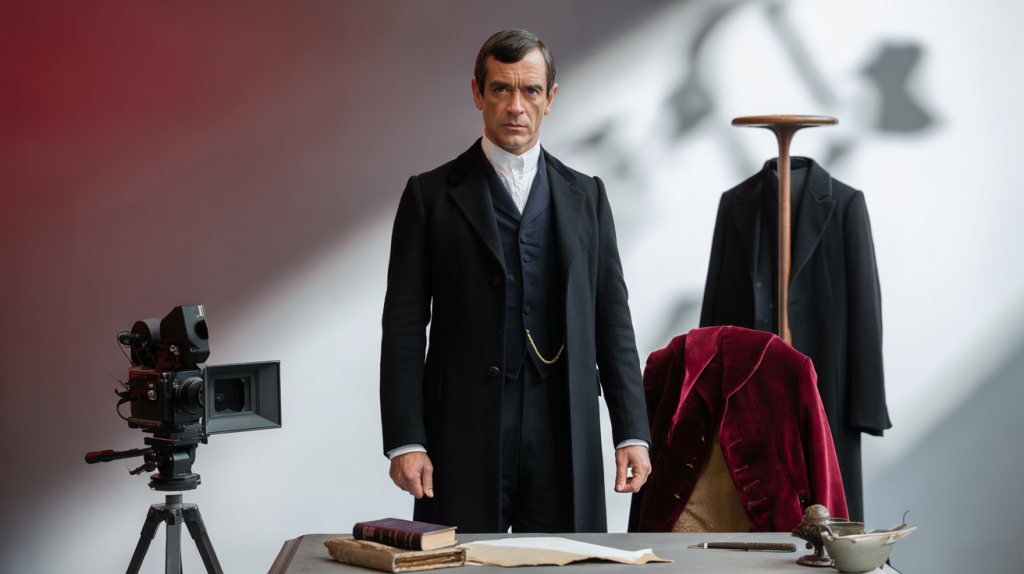
Whispers are getting louder around Victor Belmondo and a new screen take on “Le Rouge et le Noir”. The idea is simple and powerful : a rising French lead, heir to a legendary name, facing Stendhal’s most combustible hero. That kind of pairing makes readers look up and producers lean in.
Here is the state of play : as of today, no producer or distributor has issued an official press release naming Victor Belmondo as Julien Sorel. The buzz exists, the appetite is clear, and the stakes are high for any adaptation of a novel first published in 1830 by Stendhal (source : Encyclopaedia Britannica). The question everyone types into search bars is the same : is he in, and what would that change.
Victor Belmondo and “Le Rouge et le Noir” : what we know right now
The main idea lands fast. A potential casting would center Victor Belmondo on Julien Sorel, the ambitious provincial who climbs Parisian society then pays the price. Until a formal announcement arrives, the conversation revolves around timing and track record. The novel’s pedigree is heavy. It has been adapted for cinema by Claude Autant-Lara in 1954 with Gérard Philipe and Danielle Darrieux in the lead roles (source : Bibliothèque nationale de France). It returned to television in 1997 under Jean-Daniel Verhaeghe, broadcast on France 2 with Kim Rossi Stuart and Carole Bouquet (source : INA). Any new project lines up against that history.
Observation from casting desks : a believable Sorel needs intensity, youth and social mobility on screen. Victor Belmondo was born on 23 October 1993 in Paris, which puts him in the right age bracket for early chapters of Sorel’s rise and gives room for the character’s harsher turn later on (source : Allociné). His recent roles show a mix of romantic sensitivity and moral tension. That is exactly where Stendhal places the needle.
There is also a practical problem that gets solved only by official paperwork. Without a press note or a line in a distributor’s slate, all that exists are credible signals. French screen adaptations often surface first in trade listings and CNC filings, then in festival selections or UniFrance previews, weeks or months before shooting. Until then, patience, even if curiosity bites.
Who is Victor Belmondo : roles, dates, and why Julien Sorel fits
Numbers tell a story. Victor Belmondo stepped up into leading parts with “Envole-moi” released in 2021 and directed by Christophe Barratier, a mainstream audience title that positioned him with broad appeal right after theaters reopened post lockdowns (source : UniFrance). He followed with “Arrête avec tes mensonges” in 2023 by Olivier Peyon, a literary adaptation anchored by Guillaume de Tonquédec that asked for restraint and slow-burn emotion on screen, not just charm (source : UniFrance). Two years, two very different registers.
The family legacy adds context, not a shortcut. Jean-Paul Belmondo died on 6 September 2021 at the age of 88, closing a chapter of French cinema that bridged New Wave energy and popular hits across decades 1960 to 1990s (source : Le Monde). Carrying that surname can open doors, sure, but it also raises the bar every time the camera rolls. A Stendhal hero is judged line by line, gesture by gesture. No place to hide.
Concrete example of fit on theme and tone : in “Arrête avec tes mensonges”, the character’s double life and social pressures were written into each scene. That grammar is close to Julien Sorel’s inner tug of war between ambition and desire. Different century, same friction. It reads as unforgetable when played right, and the public feels it.
“Le Rouge et le Noir” today : legacy, past adaptations, and production clues
Legacy first. Stendhal’s novel arrived in 1830, at the dawn of July Monarchy, and became a reference for psychological realism in France, studied every year in classrooms and reprinted across collections for nearly two centuries (source : Encyclopaedia Britannica). The 1954 film adaptation stamped a visual memory of Julien Sorel that still circulates in cinephile circles, while the 1997 television version reached mass audiences at a time when prime time literary films on France 2 routinely exceeded the million mark in viewers according to broadcaster archives from the late 1990s (source : INA). That scale explains why new casting waves make headlines.
So how does a modern adaptation get moving. First, rights and scripts cue the schedule. Then financiers line up, followed by casting locks and a public announcement. When a lead is attached, producers typically coordinate with sales agents and festival teams to time the news cycle. Expect early signals in trade outlets, CNC production approvals that timestamp a project’s status, and updated cards on UniFrance once international sales begin. The missing piece right now is simple : an official confirmation that names Victor Belmondo alongside “Le Rouge et le Noir”. Until that line appears, the safest place to watch is where these facts are published first.