
Planning Vienna time around Helmut Lang? This guide cuts to the point: what matters, what to notice, why the city is the perfect backdrop for a fashion icon.
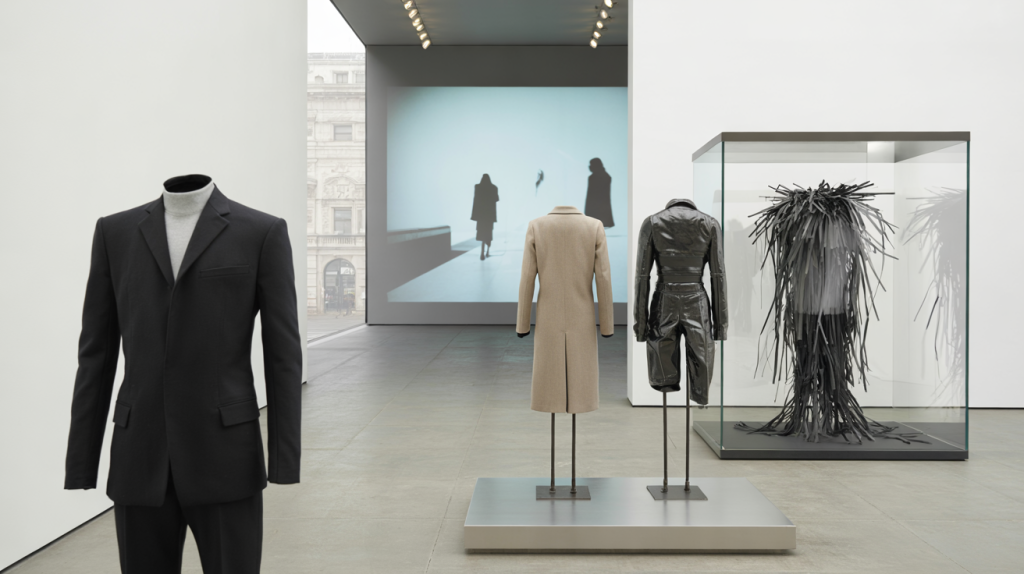
Vienna turns the spotlight on Helmut Lang, the city’s most influential fashion export. An exhibition dedicated to his radical minimalism lands with quiet power, where tailoring, tech fabrics and sculpture share the same room. Visitors step into a story that starts in Vienna and ripples across runways, galleries and the way people dress, right now.
Austrian-born in 1956, Helmut Lang launched his label in 1986, reinvented silhouettes for a new urban life, then changed the rules of fashion communication. In 1998 he live-streamed a collection online, a first for a major luxury house. He sold a majority stake to Prada in 1999, stepped away from the brand in 2005 to focus on art, and kept influencing the field from another angle. A Vienna show folds those milestones into a clear, tactile experience.
Helmut Lang in Vienna: the exhibition lens that makes sense
The city is where Lang’s sensibility took root: clarity, utility, restraint. A good Vienna exhibition threads early tailoring experiments with the sharper, industrial edge of the 1990s and the post-2005 sculptures built from salvaged materials. Expect precision suits beside felted wool, nylon or rubberized textures, plus those stark campaigns that rewired fashion’s visual language.
Dates matter here because they map the shift: 1986 for the label’s start; 1998 for the pioneering online show; 1999 for the Prada deal; 2005 for the move into art. Even the fragrance story underscores longevity, with the cult scents launched in 2000 and revived in 2014. The arc reads cleanly in vitrines and video clips, without nostalgia hanging over it.
People come looking for minimalism. They leave talking about construction. Lapels lie flatter, seams move forward, waistlines drop or rise to rebalance the body. The pieces do not shout. They recalibrate the eye.
What to look for: cuts, materials, images that defined an era
The easiest way to read Lang’s language is to break it into three zones: body, surface, signal. Then slow down. Vienna’s curators tend to give the space for that pause.
- Body: notice proportion shifts in jackets and trousers, the near-architectural armhole, and clean shoulder lines that avoid extra padding.
- Surface: track textiles from crisp cotton and worsted wool to ballistic nylon, neoprene or rubber-coated finishes that speak to city life.
- Signal: study the stripped-back ads and runway videos. The 1998 web broadcast wasn’t a stunt. It reframed how a collection meets its audience.
An archival section often includes taxi-top imagery or white-space press layouts from the late 1990s alongside garments in black, bone and slate. The message stays consistent across media: remove noise, amplify intent.
Why it resonates now: legacy, influence, numbers that tell the truth
Designers still chase these lines. Streamed shows are standard today, but in 1998 that single move nudged an entire industry toward the internet. Ownership changes did not blunt the brand’s cultural charge either: majority sold to Prada in 1999, then a transfer to Link Theory Holdings in 2006 kept the label active while Lang, the person, pursued art.
That split is not a side note. Post-2005 works often reuse shredded garments and materials, folding a fashion life back into sculpture. In a Vienna context, the art sits in dialogue with the clothes, not behind them. It clarifies how one mind moved across disciplines without losing rigor.
Visitors who followed the 1990s remember the impact in real time. Younger audiences see how today’s clean tailoring, street-ready utility and gender-fluid lines trace to seeds planted decades ago. Minimalism here is not a trend. It is a method.
How to get the most from a Vienna visit
Arrive with two tracks in mind: fashion and art. The exhibition usually lets both breathe, so plan enough time for galleries and any screening room. If a catalog is available, skim the timeline first. Anchoring on 1986, 1998, 1999 and 2005 helps keep a clear thread while walking.
Photography rules vary by room. Respect those signs. The quiet matters. It’s part of the experience. And when a label lists textile composition, read it. Lang’s choices rarely chase novelty for novelty’s sake. They solve for function, movement, weather, city living.
One last practical note: Vienna’s museum district is compact, but check the venue’s site for opening hours, ticketing and any timed-entry slots before setting out. Nothing deflates momentum like arriving at the wrong entrance or missing a time-window because of a tiny adress detail. A few minutes of prep protects the mood the show earns.