
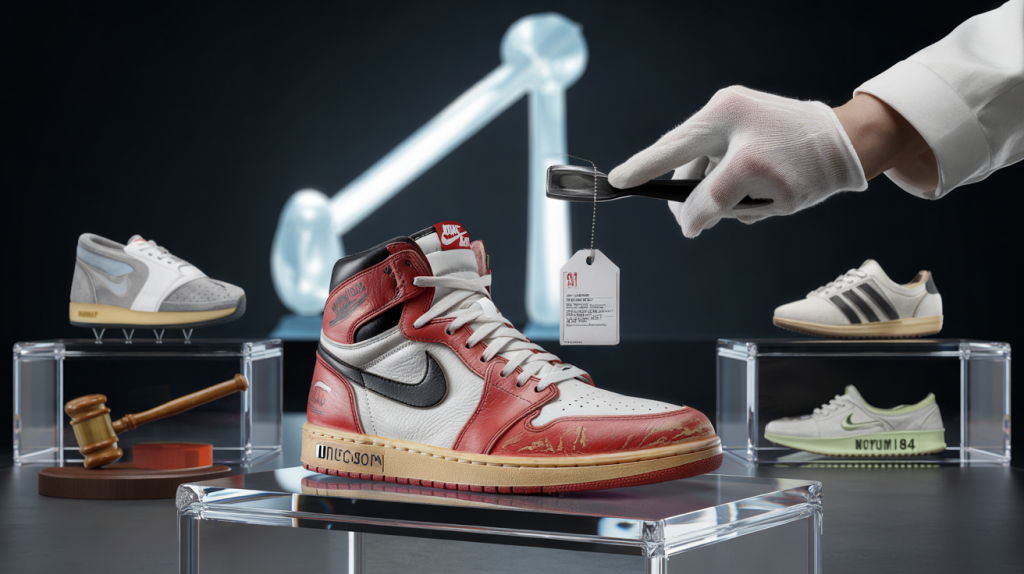
Auction hammers keep falling and the headlines tell the story : vintage sneakers are no longer a niche hobby, they are a market that behaves like art. Deadstock pairs from the 80s and 90s, once tucked away in basements, now cross the block next to watches and contemporary art.
Collectors know why demand is hot : scarcity, cultural nostalgia, and a new layer of trust through authentication. Yet the big question remains for most readers clicking today : are prices really rising across the board, and what separates a future grail from an expensive mistake?
Vintage sneakers valeur en hausse : the market shift in hard numbers
The resale market’s growth has been quantified. Cowen estimated in 2020 that the global sneaker resale economy could reach 30 billion dollars by 2030, after sizing the U.S. market near 2 billion dollars in 2019. That projected curve supports what collectors feel on the ground : more money, more players, tighter supply.
Record sales set the tone. Sotheby’s confirmed the Nike Air Yeezy 1 prototype worn by Kanye West sold for 1.8 million dollars in April 2021, the highest publicly known sneaker price. A year earlier, a pair of 1985 Nike Air Jordan 1s signed by Michael Jordan achieved 560,000 dollars at Sotheby’s in 2020. In 2019, the Nike “Moon Shoe” from 1972 reached 437,500 dollars at Sotheby’s. These numbers reset expectations for vintage pairs with story and provenance.
Macro forces nudge buyers too. U.S. inflation peaked at 9.1 percent in June 2022 according to the Bureau of Labor Statistics, pushing some collectors toward tangible assets. Platforms responded on trust : eBay announced its Authenticity Guarantee for sneakers in October 2020 in the U.S., a move that lowered frictions for first time buyers and sellers.
Auctions, brands and eras leading the surge : Nike, Adidas and the 80s-90s
Not every vintage lane rises the same way. Early Nike running heritage draws serious bids when pairs link to innovation or athletes, as seen with the 1972 “Moon Shoe”. Basketball dominates value retention for 1980s Nike Air Jordan and select Adidas Forum pairs, since cultural impact and media footage anchor demand beyond fashion cycles.
Prototypes and player exclusives sit in a different league. The 2021 Yeezy prototype demonstrated how a one-off can leap past even the most coveted GR. For accessible targets, original colorways from 1985–1995 and early 2000s retros with era-correct shapes tend to hold better than trend-driven collabs with no archival story.
Authentication infrastructure matters in price discovery. eBay’s 2020 program and third party services helped reduce counterfeit risk, allowing higher price ceilings for older pairs in top condition. Without that layer, many buyers stayed sidelined.
Common mistakes and smarter buying : condition, provenance, storage
The biggest trap is confusing hype with durability. Vintage midsoles can crumble, glues can dry, and leather can crack. A pair can be museum worthy yet unwearable. That is fine if the goal is collecting, not daily rotation.
Pricing slips also happen when provenance is vague. Receipts, original boxes, hangtags and photos of the pair over time build confidence. Auction catalogs and brand archives are useful cross checks for details like stitching, labels and country of manufacture.
For readers building a method, a quick checklist helps before any bid or Buy It Now :
- Look for original colorways and first runs from the 80s and 90s, with box and accessories.
- Verify authenticity through reputable services or platforms with written guarantees.
- Assess materials honestly : midsole type, glue lines, and signs of prior repairs.
- Check actual sold prices on trusted marketplaces and auction results by date, not asking prices.
- Plan storage : cool, dry space, acid free paper, and rotation to avoid moisture build up.
What could push prices next : supply, culture and smarter timing
Supply is finite for true vintage. Brands can reissue shapes, but they cannot mint 1985 pairs. That scarcity, paired with recurring cultural spotlights in film, streaming and athlete storytelling, keeps new cohorts entering the market each year.
Reissues cut both ways. A faithful retro can lift interest in the original, while an oversupplied remake can cool short term prices. Watching brand calendars and auction previews gives early signals. When Sotheby’s schedules a themed sale tied to a documentary or anniversary, liquidity often follows.
For those stepping in now, the solution is boring and effective : buy fewer, buy better, and document everything. Use third party authentication, compare condition with past lots, and favor pairs with verifiable history. That definetly reduces risk, and in a market where valeur en hausse is real but uneven, it is the missing piece between an expensive shelf piece and a long term asset.