
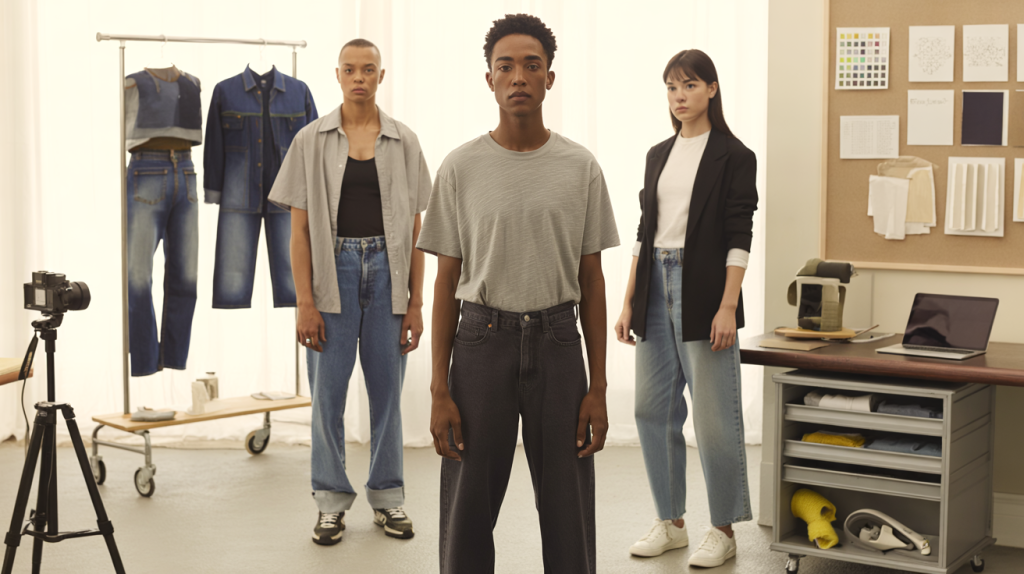
Walk into a creative studio and notice the quiet pattern. The sharpest minds often show up in the simplest look, jeans and a tee shirt, nothing fussy, all intention. This is not laziness. It is a system that frees attention for the work, gives a clear silhouette on camera, and reads effortless with clients.
The idea is straightforward. A consistent outfit reduces small decisions, signals a point of view, and stands up to the long, messy hours of making. The reference list runs long, from tech founders to art directors, yet day to day the uniform lives on the floor of real teams, where denim and a soft cotton tee win on comfort, durability, and recognizability.
Designer uniform and focus : the case for fewer choices
Decision fatigue is real, and it hits busy creatives first thing in the morning. In 2011, a study in Proceedings of the National Academy of Sciences reported that favorable rulings by judges started around 65 percent, then dropped to near zero before breaks, rebounding after a rest, a striking pattern tied to decision load and glucose availability. Source : Danziger, Levav, and Avnaim-Pesso, 2011.
Mark Zuckerberg said the quiet part out loud in 2014, explaining his gray tee streak during a Facebook Q and A : “I really want to clear my life to make it so that I have to make as few decisions as possible about anything except how to best serve this community.” One sentence, a whole strategy for mental energy.
Clothes also shape cognition. The term “enclothed cognition” entered the conversation in 2012 when researchers reported that wearing a lab coat described as a doctor’s coat improved selective attention on tasks. Source : Journal of Experimental Social Psychology, Adam and Galinsky, 2012. Different garment, same lesson, what we wear nudges how we think and perform.
From Levi Strauss to Steve Jobs : denim and the tee with cultural gravity
Denim earned its workhorse status early. Levi Strauss and Jacob Davis secured U.S. Patent No. 139121 for riveted work pants on 20 May 1873. The fabric kept doing hard jobs, then crossed into pop culture and design studios without losing its backbone.
The plain white tee turned iconic on screen in 1955, when James Dean wore it in “Rebel Without a Cause.” After that, the combo needed no explainer, just better fits and better mills.
Modern minimal uniforming has high profile champions. Steve Jobs standardized on a black Issey Miyake turtleneck, Levi’s 501 jeans, and New Balance sneakers, a choice documented in Walter Isaacson’s 2011 biography. The formula landed because it stayed consistent, photogenic, and fast.
Build your own designer uniform : fit, fabric, color that work
Start with one silhouette that suits your body and your work. Treat it like a tool, not a costume.
Denim matters. Midweight, a touch of stretch if you sit and sprint all day, sturdy hardware, and pockets that lie flat on camera. Dark indigo reads sharper than light wash in meetings, while a gently faded pair looks relaxed on set.
A tee should be soft yet opaque. Combed cotton holds shape, organic cotton feels kinder on skin, a dab of elastane resists twisting. Neckline depends on your build. Crew frames the face, a shallow V opens the chest for balance.
Color is strategy. Neutrals keep the brain on the brief, not the outfit, and they layer cleanly under chore jackets or blazers when a client walk through pops up unplanned.
Here is a simple, repeatable setup that many designers adopt, then forget about day to day.
- Two pairs of jeans, one dark, one mid wash, rotated by day
- Five identical tees in a single neutral, plus two in a seasonal tone
- One light layer, one structured layer, both in textures not prints
- Work sneakers for the studio, leather sneakers for client time
- A small drawer kit, lint roller and travel steamer, saves shoots
Keep it fresh : variety inside the uniform, cost and care that last
Uniform does not mean boring. Texture swaps, like slub cotton against smoother denim, create depth on camera without changing the palette. Stitch details, pocket shapes, and rise height shift the look just enough for the eye.
Cycle pieces on a calendar to prevent wear-out. Three to six month checkpoints help, jeans can rest between wears to recover shape, tees retire to sleep rotation when collars soften. Sounds fussy, yet it is ultimately friction reducing.
Care is leverage. Cold wash, inside out, mild detergent, low spin, hang dry. The fabric keeps color, seams live longer, and the silhouette remains consistent across copies. That consistency makes the uniform truly look intentional, not thrown on.
One last nudge, a uniform reduces shopping churn and photo inconsistency across client decks, which cuts micro stress during deadlines. You feel lighter, the team reads you instantly, and the work stands front and center. That is the whole point, definately.