
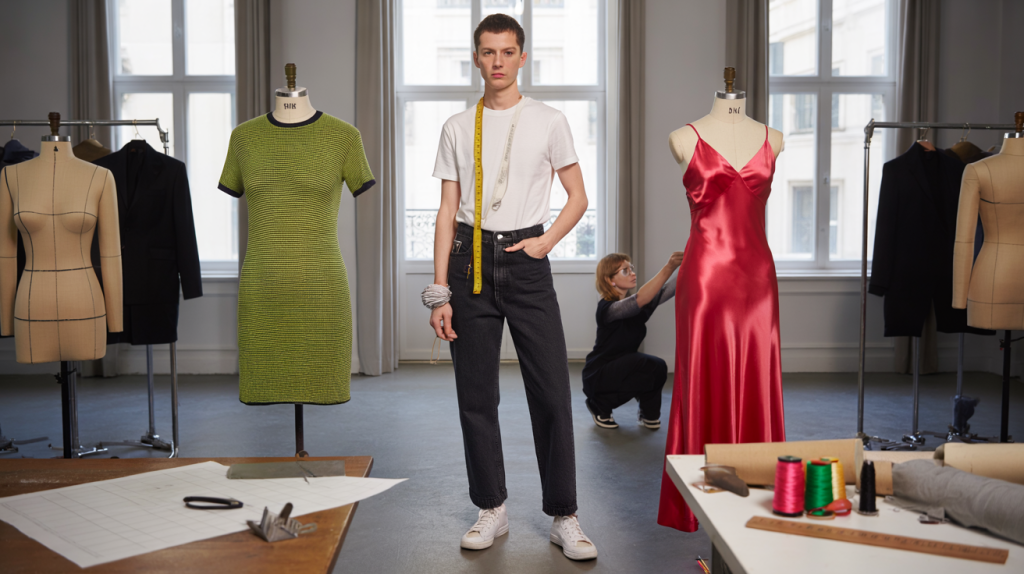
Two pieces. Endless impact. Across studios from Paris to New York, the simplest look in the room keeps showing up on the most discerning people there : jeans and a T‑shirt. Designers lean on it to judge silhouettes with a clear eye, to move through fittings fast, and to stay credible without stealing focus from the clothes that must shine.
The combo acts like a uniform that speeds decisions and reduces noise. It reads neutral next to a neon knit or a bias-cut satin dress. It lets hands dive into pockets during castings, pins click against denim on a hem, and measurements land without fuss. The message is stark : the ideas matter, not the outfit on the designer.
Why fashion designers choose jeans and T‑shirt at work
Main issue first : creative work needs consistent conditions. A stable base outfit keeps color, proportion, and movement comparable from day to day. That helps spot whether a sleeve rides up because of the pattern, not because a chunky sweater underneath shifted the line.
There is a cognitive layer too. A 2011 study in Proceedings of the National Academy of Sciences by Shai Danziger, Jonathan Levav, and Liora Avnaim‑Pesso showed how decision quality plunged before breaks and rebounded after, a classic decision fatigue curve. A steady uniform cuts tiny choices, protecting mental energy for the collection.
Culture made the combo universal, so it communicates across teams and generations. The U.S. Navy formalized the T‑shirt as standard underwear in 1913, then cinema turned it into an icon in the 1950s with Marlon Brando and James Dean. Denim’s modern arc started earlier : Levi Strauss and Jacob Davis secured the rivet patent in 1873, then jeans traveled from workwear to rebel to runway with no translation needed.
From Levi Strauss to James Dean : how denim and the T‑shirt became a design tool
Designers use the pair like a ruler for the eye. Dark straight jeans tell the truth about cut and drape more reliably than pleated trousers. A mid‑weight cotton tee reveals how a jacket shoulder breaks, how a neckline frames the clavicle, where a dart should land. No showboating, just clean references.
It also signals accessibility. Michael Kors often steps out in black T‑shirt and denim. Phoebe Philo champions refined basics that whisper, not shout. Virgil Abloh mixed tees with tailoring in ways that made couture conversations feel open. The uniform says : this is for real life, not just the set.
Numbers behind the uniform : data that explain the choice
Market scale shows why this look reads instantly. Grand View Research valued the global denim jeans market at about 64.6 billion dollars in 2022, with growth projected through 2030. That is ubiquity stitched into daily life.
On tees, Grand View Research also tracked a booming custom T‑shirt printing market, around 4.3 billion dollars in 2022, boosted by teams and creators. When a garment is everywhere, it becomes a neutral testing ground. Everyone can picture how a coat sits over a white tee and indigo denim.
The speed factor matters accross the fashion calendar. From fabric fairs in February to final fittings in September, teams race. A uniform trims prep time and lowers friction in meetings, so the day starts focused instead of negotiating outfits.
Style playbook : how to nail the jeans and T‑shirt like a designer
Here is the missing piece : the combo only works if the details are tight. Fit, weight, and finish do the heavy lifting.
- T‑shirt weight : 160 to 200 g/m² keeps structure without stiffness. Heavier for jackets, lighter for summer.
- Neckline height : a classic crew that hugs the neck frames blazers cleanly. Slightly wider crews soften leather jackets.
- Sleeve length : mid‑bicep reads tailored, longer sleeves feel casual. Roll once for fittings.
- Jeans rise : mid to high rise stabilizes proportion with cropped tops and long coats.
- Leg shape : straight or slim‑straight shows shoe lines and does not fight silhouette.
- Wash : solid indigo or flat black reduces visual noise when judging color stories.
- Shoes : clean sneakers for floor days, pared‑back boots when hems need testing.
One last studio truth : fabrics talk. A crisp tee shows where a lapel pulls. A rigid raw denim flags pocket placement on outerwear. Keep two identical sets in rotation, log alterations, and photograph fittings with the same uniform for consistent comparisons. The result is a quiet framework that lets creativity go loud where it counts, on the clothes themselves.