
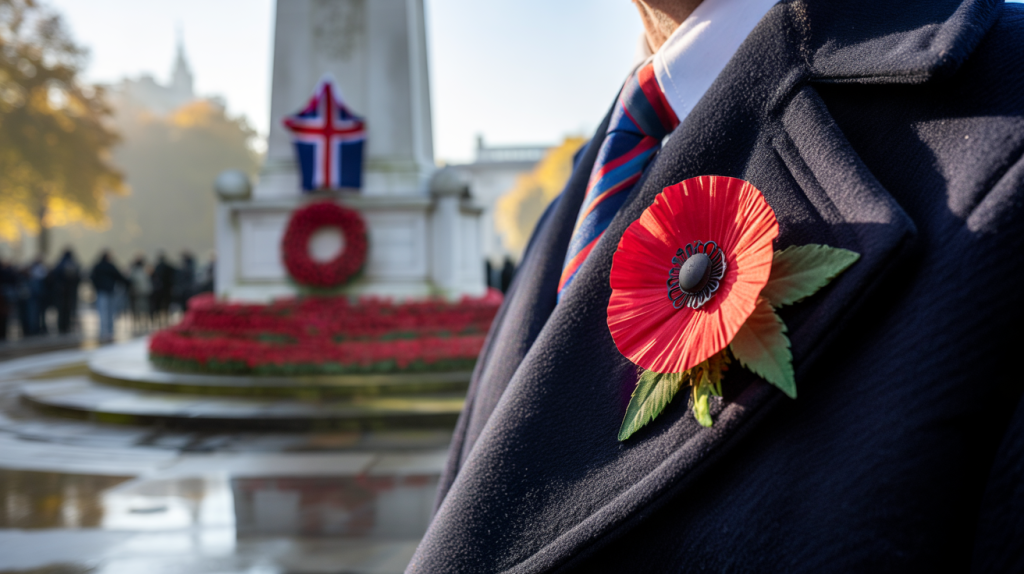
November in the United Kingdom changes the street view in a heartbeat. Red paper flowers appear on coats, uniforms, TV studios, and at football matches. One glance, and a shared memory returns.
The poppy signals remembrance for those who died in war and a living commitment to support veterans. It has funded help for families, rehabilitation, and mental health services through the Royal British Legion. The tradition has endured for a century, and it still speaks to people who never met a veteran yet feel the weight of the silence at 11.00 on 11 November.
Why the English wear a poppy in November
Here is the point. The red poppy is worn in the run up to Armistice Day on 11 November and on Remembrance Sunday, the second Sunday of November. People wear it to remember those who died in the First World War and in later conflicts, and to raise funds for veterans and their families through the Poppy Appeal of the Royal British Legion.
The symbol has become part of public life. Schools hold assemblies, businesses invite donations at reception, and broadcasters pin poppies during early November. The Legion has stated that wearing a poppy is a personal choice, and that there is no right or wrong way to wear one.
From Flanders Fields to the Royal British Legion
The flower comes from a battlefield image. In 1915, Canadian doctor John McCrae wrote the poem “In Flanders Fields”, after burying a friend near Ypres. Poppies had covered the churned earth of the Western Front. The words travelled fast.
In 1918, Moina Michael in the United States started wearing a poppy to remember the fallen. French fundraiser Anna Guérin promoted artificial poppies to support orphans and veterans in 1921. That same year, the newly formed Royal British Legion adopted the poppy and launched the first Poppy Appeal in the United Kingdom.
The two minute silence at 11.00 on 11 November was introduced in 1919 by King George V, a practice that has continued. According to Imperial War Museums, the silence marks the exact hour the guns fell quiet in 1918, and it creates a national moment to reflect on loss and service.
Remembrance Day and Remembrance Sunday in the UK
Remembrance Day falls on 11 November. Remembrance Sunday takes place on the closest Sunday, when national ceremonies are held at the Cenotaph in London and at local memorials. The Commonwealth War Graves Commission cares for around 23,000 sites in more than 150 countries and territories, commemorating about 1.7 million men and women of Commonwealth forces, figures that explain why the rituals feel so extensive.
People often ask how to wear a poppy. The Royal British Legion has said there is no single correct way, though many choose the left lapel near the heart. Some pin it on coats or bags. Others use a stick on poppy for safety at work. No pressure, the choice belongs to each person.
Common mistakes come from good intentions. Some think the poppy supports war, which it does not. It supports those affected by war. Others feel they must wear it on air or at events. The Legion has repeated that it is voluntary, and that donations fund care for veterans who have served since 1921, through grants, outreach, and recovery programmes.
For those who want simple etiquette without stress, this helps.
- When to wear it : from late October until 11 November or Remembrance Sunday.
- Where to place it : any visible spot on clothing or bag, many choose the left side.
- What to do on the day : pause for the two minute silence at 11.00 on 11 November.
- How to donate : buy a paper poppy, tap to donate via contactless boxes, or give online to the Royal British Legion.
Red, white, purple poppies : meanings and debates
The red poppy remains the most visible symbol. It has raised funds for a century through the Poppy Appeal, which has become one of the largest annual charity drives in Britain. Many families keep a poppy year after year, a small object with a weighty memory.
Other colours exist. The white poppy, first introduced in 1933 by the Co operative Women’s Guild and now distributed by the Peace Pledge Union, remembers all victims of war and highlights peace building. The purple poppy, promoted by Animal Aid since 2006, honours animals that served in conflict. These alternatives appear each November and sometimes spark debate about symbolism in public life.
Ceremonies evolve, the core remains clear. The nation has observed the silence since 1919, has read the names at memorials, and has worn a poppy that began in a poem and became a lifeline for those who served. On this ocassion, small rituals carry big stories, and they have linked generations across a century.