
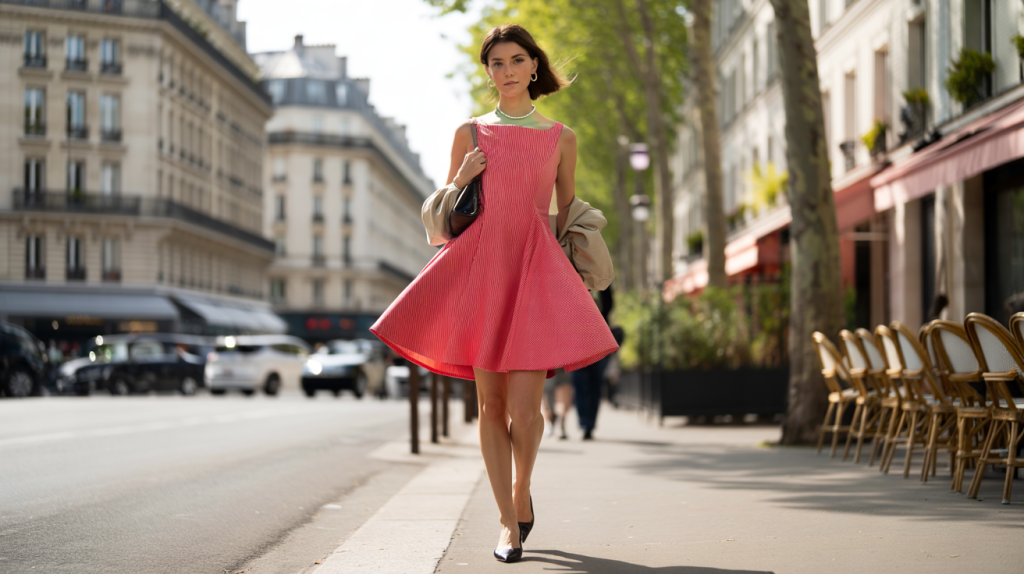
One clean line. One easy swing. The French trapeze dress keeps returning to the front row of everyday wardrobes, from Paris arrondissements to summer holidays by the Atlantic. The cut stands slightly away from the body, floats when walking, and somehow looks polished without trying. That mix is the point: French women reach for it when the plan is to look composed and free at once.
The idea isn’t new. Yves Saint Laurent unveiled the “Trapeze” line in 1958 for Christian Dior, releasing the waist and letting the dress flare from the shoulders – a small revolution after the cinched 1950s (source : Musée Yves Saint Laurent Paris). Fashion historians also note that Christian Dior’s earlier “A-Line” appeared in spring 1955 and paved the way for that swingy geometry (source : The Metropolitan Museum of Art, Heilbrunn Timeline). The shape survived trends because it solves a daily problem: looking refined without tightness or fuss.
French Trapeze Dress: what it is and why it works
The trapeze silhouette widens gently from collarbone to hem. No waist seam, no cling. It skims the bust, clears the hips, and ends above the knee or at midi length. On the body, the effect reads fresh and airy.
Warm days prove its strength. The fabric moves, air circulates, and posture stays easy. Commuting, a quick lunch, a last-minute apéro – the dress adapts, especially in cotton poplin, crisp twill, or light wool crepe.
The cut also photographs well. Clean necklines frame jewelry, sleeves balance proportions, and the hem gives motion. That’s why the silouette shows up in street style every season, even when trends churn.
A short history : Dior 1955 to Yves Saint Laurent 1958
Spring 1955 : Christian Dior presented the “A-Line,” a narrow-shouldered look that flared outwards, shifting attention from the waist to the whole outline (source : The Metropolitan Museum of Art). It prefigured the freedom to come.
1958 : At just 21, Yves Saint Laurent introduced the “Trapeze” for the house of Dior, cutting the dress to swing from the shoulders and softening the torso’s architecture (source : Musée Yves Saint Laurent Paris). The move helped women step into the 1960s with ease.
By the mid-1960s, hemlines climbed, and above-the-knee trapeze and shift dresses became weekday staples, especially in city life (source : Victoria and Albert Museum). The legacy endures in modern versions: shorter for summer, midi for work, and evening versions in satin or faille.
How to style a trapeze dress today
Start with proportion. The volume lives up top, so shoes and outerwear should anchor the look without adding bulk. Think clean lines, low profile accessories, and one focal point.
Color helps. Navy and black keep it sharp for the office. Ecru or poppy red feels French on weekends. A micro-print reads lively without noise, while stripes nod to seaside style.
When the weather turns, add structure through tailoring. A cropped jacket or short trench sharpens the swing. Long cardigans can swamp the line, so keep layers neat.
For quick wins, this checklist rarely misses :
- Footwear : ballet flats for day, block-heel sandals for dinners, slim ankle boots for fall.
- Outerwear : cropped blazer, short trench, or a neat denim jacket.
- Accessories : small shoulder bag, fine-chain necklace, hoop earrings; keep scale light.
- Belt? Optional. A thin belt can transform it into a soft A-line, but the pure trapeze flies better unbelted.
- Lengths : mid-thigh for weekends, just above the knee for office, midi for events.
Buying guide : fabrics, fit, and care worth your budget
Fabric sets the tone. Cotton poplin holds a crisp bell shape that reads daytime and clean. Silk or viscose adds drape for evenings. Lightweight wool crepe carries into autumn without feeling heavy.
Lining matters. An unlined summer dress feels breathable and breezy. For satin or light colors, a full lining prevents show-through and helps the skirt swing smoothly. A good lining often signals better construction.
Watch the neckline and sleeve. A boat or V neckline elongates the neck. Short sleeves or bracelet-length sleeves balance the volume nicely. If fuller-busted, a subtle V can open the line and keep the upper body from feeling boxy.
Care and longevity pay off. Quality stitching along the armhole and hem keeps the flare true after washing. Many heritage examples from the late 1950s survive in museum collections because the cut and make were robust (sources : Musée Yves Saint Laurent Paris, The Metropolitan Museum of Art). On the modern market, vintage and secondhand platforms have expanded access to well-made trapeze pieces, with Vinted passing 100 million members globally in 2024, a sign that circular fashion keeps growing in reach (source : Vinted company updates, 2024).
One last detail : movement. Step, sit, climb stairs. The hem should not ride up, and the dress should swing back into shape without tugging. When that happens, the trapeze does what French wardrobes expect of it – effortless elegance, on repeat.