
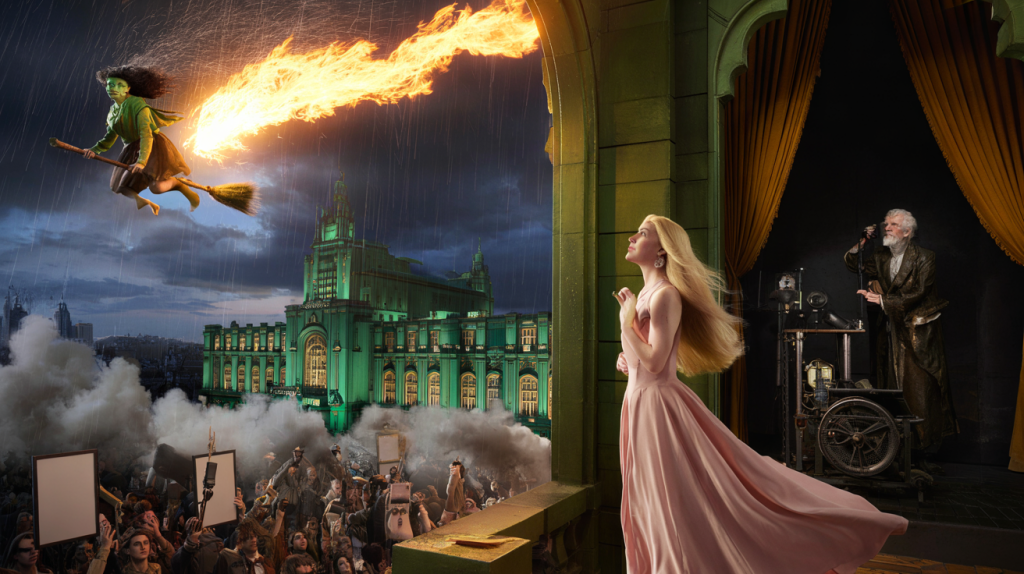
Wicked fin expliquée: the last flight crowns Elphaba the “Wicked Witch” and locks Glinda on a different path. Here is what that ending really sets in motion.
That final image sticks. Elphaba bursts into the night, broom igniting, voice peaking, and Oz names a new villain. The ending of the 2024 film Wicked: Part One is not a neat bow. It is a pivot. Elphaba chooses integrity over approval, Glinda chooses safety over disruption, and the Wizard’s lie machine gets its perfect foil. That is the point of the cliffhanger: identity is now public, and it cuts both ways.
Context matters. Director Jon M. Chu confirmed in April 2022 that Wicked would be told in two parts, dated for late 2024 and late 2025, echoing the two-act shape of the Broadway musical that premiered in 2003. Part One stops where the stage show’s Act I stops, on the high-voltage number “Defying Gravity”. The meaning is simple on paper yet messy in hearts: Elphaba breaks with the Wizard after learning his power sits on manufactured fear, then she claims her own power in plain sight. Glinda stays. Oz spins the story.
Wicked ending explained: Elphaba’s flight and a reputation sealed
The film builds to the meeting with the Wizard, played by Jeff Goldblum, that turns from dream to disillusion in minutes. Elphaba brings talent and hope. She finds a showman who runs Oz on smoke, levers and convenient scapegoats. When she refuses to help, Madame Morrible, portrayed by Michelle Yeoh, snaps into propaganda mode. Labels arrive fast. “Wicked” lands first, truth last.
The broom rising is not just spectacle. It signals a transfer of power. Elphaba stops seeking permission and uses the Grimmerie, the spellbook that only she can read, to vault free. The Emerald City watches a silhouette in the sky and accepts the headline. That is how the ending works: the audience sees liberation, the citizens below see threat. Two realities, one moment.
Glinda, played by Ariana Grande, does not miss the fork in the road. She stays near the Wizard, a choice that buys influence and costs trust. It hurts, and the film lets that hurt sit. Cynthia Erivo’s Elphaba does not look back for long. The friendship survives in memory, not in action, which is exactly why the ending feels so human and definitly unresolved.
From Broadway 2003 to the 2024 film: what changed and what stayed
The spine remains the same as the long-running stage hit that opened in New York in 2003 with music and lyrics by Stephen Schwartz and a book by Winnie Holzman. Act I ends on “Defying Gravity”. Two friends separate. A public enemy is born. That structure lives intact in the movie.
The film adds scale, not new plot at the last beat. A larger Emerald City, closer looks at Shiz University, and more time with side characters, including Jonathan Bailey’s Fiyero, deepen the fractures that explode in the finale. Yet the core meaning mirrors the source, which itself adapts Gregory Maguire’s 1995 novel and nods to L. Frank Baum’s 1900 classic.
Dates help map the intent. The two-part format, announced in 2022, telegraphs that Part One would stop where the musical’s first act stops. Release landed on 22 November 2024 in the United States. The pause is deliberate. It gives the consequences room to breathe.
Clues tucked in the final scenes: Glinda, Fiyero, the Wizard
Watch how Glinda faces the crowd after Elphaba lifts off. Her smile hardens a touch too long. That is not villainy. It is survival inside a stage-managed city. The ending primes her to sell comfort to Oz while wrestling with that choice in private.
Fiyero looks small in a city of big voices. His brief but unsettled gaze toward Elphaba during the fallout hints at a pull that politics cannot cancel. The film plants that seed without shouting it.
The Wizard’s reaction tells the rest. He does not chase, he brands. Words become the weapon, and Madame Morrible is happy to aim them. In a story about power without magic, that is the sharpest trick: define the narrative before anyone asks questions.
For viewers who want a quick map of the last minutes, the beats run straight, then bend hard.
- Elphaba exposes the Wizard’s sham, refuses to comply, and becomes the target of a smear.
- Glinda stays in the palace, positioned as the good face of a troubled regime.
- Elphaba claims the Grimmerie and her broom, flies into a storm of headlines and becomes “the Wicked Witch”.
What comes next, based on the source material and the two-film plan
The film stops on rupture, not resolution. That is by design. The Broadway Act II, which informs Part Two, wrestles with consequences: how a label reshapes a person, how friends try to mend damage inside a regime that punishes dissent, how Oz handles truth once it leaks. The novel lineage, from 1995 back to 1900, supplies familiar faces that have not yet entered the film’s frame, which the final image quietly makes space for.
None of this undercuts the ending you just saw. It explains why it hits so hard. The flight is freedom, the roar below is control, and the gap between them is where the second film lives. Until then, the last shot does its job. It answers the “why now” and leaves the “what next” poised, just as the 2003 stage version has done for two decades.