
Turn the longest night into a warm ritual. Science, simple ideas, and time tested traditions to celebrate the winter solstice with meaning at home or outside.
The longest night arrives, and with it a quiet promise. The winter solstice marks the tipping point when darkness peaks and daylight starts its slow return. Many people look for a simple, meaningful way to honor that shift right now.
Here is the core: in the Northern Hemisphere, the winter solstice typically falls on 21 or 22 December, when Earth’s 23.4 degree tilt turns the North Pole farthest from the Sun, creating the year’s shortest daytime and longest night. NASA explains that this tilt drives seasons, while timeanddate data shows day length begins to grow immediately after the event, second by second depending on latitude.
Winter Solstice Meaning : science, date and light
Think of a hinge in the year. The solstice is that hinge, the instant the Sun reaches its southernmost point in the sky for the Northern Hemisphere. According to NASA, Earth’s axial tilt of about 23.4 degrees sets this moment and repeats every December and June.
Timing shifts by location and year. Timeanddate notes the December solstice can land anywhere from 20 to 23 December, most often on the 21st. Far north, the difference feels huge. On the solstice, Reykjavík sees roughly 4 hours of daylight, while Madrid enjoys about 9 hours, based on timeanddate city records.
Light then rebounds. The day after the solstice, daylight increases in tiny steps, larger the farther you live from the equator. The latest sunrise and earliest sunset do not fall on the same date, an effect astronomers call the equation of time, tracked by observatories and explained in plain terms by timeanddate.
How to Celebrate the Winter Solstice at Home
The night invites small, sensory rituals. Keep it simple. People often choose light, warmth, seasonal food, and a short pause to mark the turning of the year.
One practical note helps the mood and the bill. The U.S. Department of Energy reports LED holiday lights use at least 75 percent less energy than incandescent strands and last up to 25 times longer, a neat way to glow brighter while saving power.
Use the ideas below as a menu. Take one or two. That is enough.
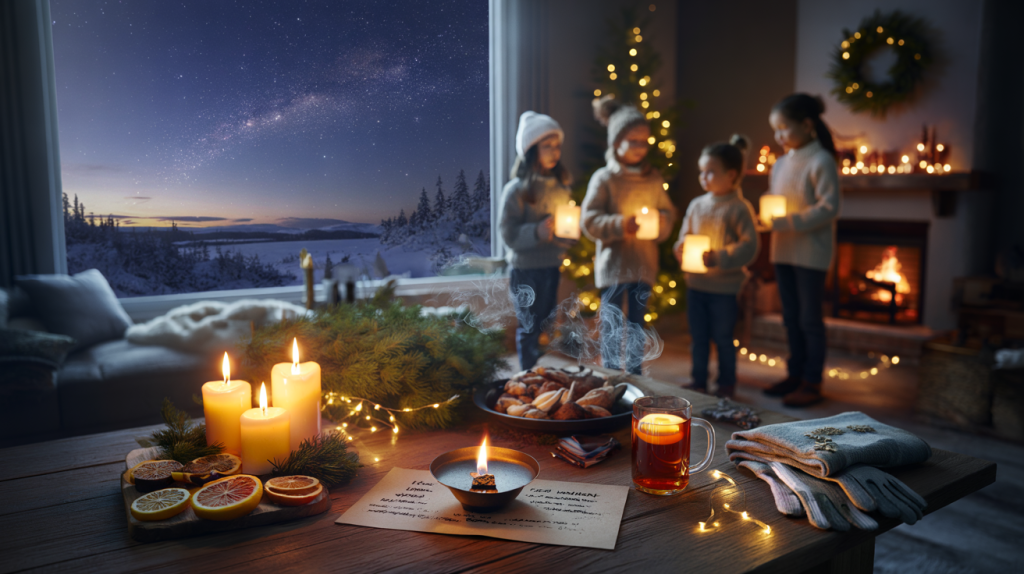
- Five minute lights out, then light candels or LEDs and share a wish for the return of light.
- Cook something seasonal like citrus slices with cloves, roasted root vegetables, or spiced tea that steams up the room.
- Step outside for two minutes of stargazing. No telescope needed. If skies are clear, look south for Orion rising mid evening in December.
- Write what to release on scraps of paper and safely burn them in a fireplace or metal bowl. Then write one intention for longer days.
- Gift warmth. A pair of gloves to a neighbor, a blanket to a shelter. Short nights for someone else feel longer without heat.
- Create a dark corner. Dim phones, switch off screens, let eyes adjust, then bring in a single small light to anchor the room.
- Take a quiet nature walk earlier in the day. Notice the low Sun angle and long shadows that define this season.
Traditions and Rituals : Yule, Saturnalia and Stonehenge
Past generations turned the solstice into festival time. In Northern Europe, Yule centered on evergreen boughs, fire and shared feasts, symbols of endurance through winter. Elements of Yule live on in modern evergreens and candles.
Rome went big. Encyclopaedia Britannica notes Saturnalia began on 17 December and, by the late Republic, stretched to 23 December, known for gift giving, greenery and role reversals at banquets.
Monuments carried the sky into stone. English Heritage documents that Stonehenge aligns with the midwinter sunset, and crowds still gather for sunrise and sunset watchings. The organization has streamed the event in recent years, bringing the solstice to people far from Salisbury Plain.
Community and Wellbeing : light, nature and shared moments
Short days test energy. Chronobiology research shows morning light supports circadian timing and mood, a simple practice that pairs well with a solstice dawn walk. Even on cloudy days, outdoor light is stronger than typical indoor lighting.
Shared rituals help. A neighborhood lantern walk, an early supper by candlelight, or a music circle turns a dark evening into connection. Schools and libraries often host craft sessions with paper lanterns or orange pomanders, safe, low cost and fragrant.
Geography shapes the feel of the night. In Tromsø, above the Arctic Circle, the Sun stays below the horizon during the polar night period, while cities like Chicago still see about 9 hours of daylight on the solstice, according to timeanddate records. Adapting celebration to local light makes the experience authentic instead of scripted.
Safety keeps the glow steady. If using real candles, place them on stable, nonflammable surfaces and never leave them unattended. For families, battery LEDs deliver the same mood with far less risk and, as the U.S. Department of Energy notes, far less energy use.