
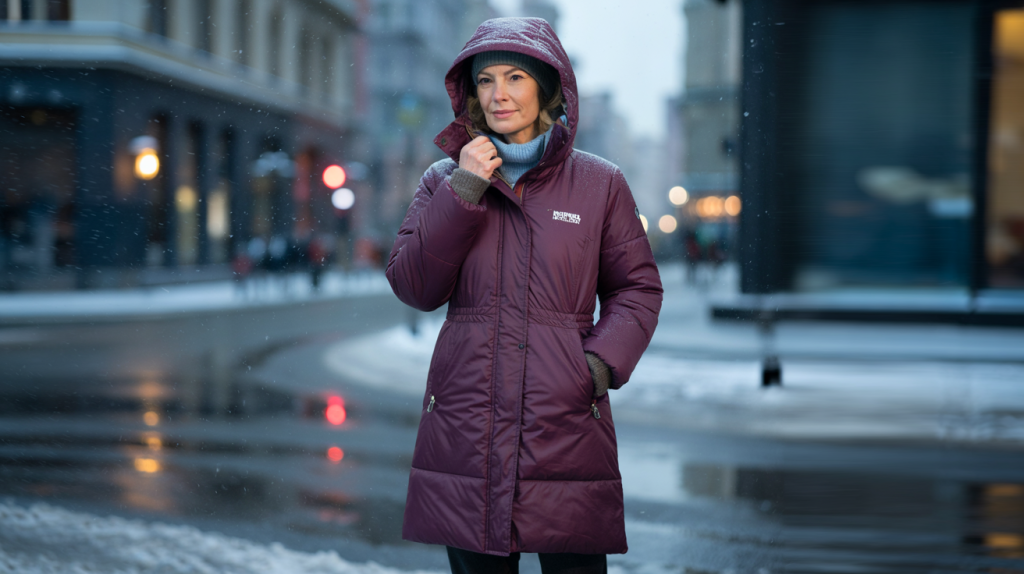
Freezing wind at the bus stop, wet snow on the sidewalk, a rush to get out the door. A “manteau long femme très chaud” solves that in one move: locked-in warmth from shoulders to shins, without feeling bulky or stiff. The right pick blends insulation, weather protection, and smart design details that stop heat from escaping where it usually does.
Here is the core: length that covers your thighs, insulation that traps air, and a shell that blocks gusts. Numbers help cut through marketing. ASHRAE Standard 55 states that 1 clo equals 0.155 m²K/W, a unit used to describe clothing insulation, with full winter ensembles commonly near 2 clo for real cold (ASHRAE 55-2020). Wool can absorb up to 30% of its weight in moisture without feeling wet, says The Woolmark Company. Those two facts alone explain why fabric and construction, not just looks, decide if a coat truly feels warm outside.
What makes a “manteau long femme très chaud” actually warm
Start with coverage. Heat escapes fast at the neck, front zipper, wrists, and down the legs. A longer hem adds a physical barrier, so your core stays stable when sitting, cycling, or waiting in line with wind in your face. Yes, length matters.
Insulation must trap air and keep loft. In practice, that warmth links back to clo. ASHRAE’s benchmark shows how layers add up to comfort, and why a coat alone cannot fix thin underlayers in sub-zero weather. The jacket’s job: deliver high insulation for the torso and upper legs and reduce drafts so layers underneath can work.
Wind protection multiplies the benefit. A tightly woven or laminated shell cuts convective heat loss, while a high collar, storm flap, and snug cuffs stop the classic cold leaks that make even thick coats feel chilly. One weak point and the whole system underperforms.
Materials that win in deep winter: down, wool, and advanced synthetics
Down remains the benchmark for warmth-to-weight. Fill power signals the quality of loft; higher numbers generally trap more air per gram. The International Down and Feather Bureau explains that fill power measures the volume occupied by a set mass of down under standard conditions, a key performance indicator for thermal efficiency (IDFB).
Wool fights cold differently. The Woolmark Company reports wool can absorb up to 30% of its weight in moisture without feeling wet, which helps regulate microclimate when snow melts on contact or commutes turn sweaty mid-journey. Dense melton wool blocks wind better than loose knits, so weave density matters as much as fiber.
Synthetic insulation stays resilient in damp conditions and dries quickly. Many brands now use recycled polyester fill and shells. Textile Exchange noted in its 2023 report that recycled polyester represented 14.8% of global polyester use in 2021, a sign that warm options can also align with lower-impact choices.
Buying checklist: choose the right long warm coat for women
When racks are full and tags all claim “warm”, this simple checklist keeps the focus on real-world heat, not hype.
- Length : mid-calf or just below the knee for daily city cold; add a littel longer hem for static waits in open wind.
- Insulation : high-loft down for dry, frigid days; synthetic for mixed wet snow; dense wool blend for urban wind and daylong wear.
- Shell : tightly woven or laminated fabric with a windproof rating; taped or at least well-covered seams along the zipper line.
- Closures : two-way zipper to sit comfortably, storm flap with snaps, fleece-lined pockets, and an adjustable hood that seals around the face.
- Cuffs and hem : rib or gasket cuffs, plus a drawcord hem, to block drafts that rob heat fast.
- Fit : room for a mid-layer without compression; if the coat looks puffy but feels tight, you lose loft and warmth.
- Care labels : down that is responsibly sourced and machine-dryable to restore loft; wool that can be professionally cleaned without felting.
Care, layering, and real-world warmth: small moves that change everything
Layers decide comfort as much as the coat. A breathable base layer wicks moisture, a light fleece or wool sweater adds steady insulation, and the long coat seals it all from wind. That stack lines up well with the clo concept from ASHRAE: each layer adds insulation, but only if the system does not get crushed or soaked.
Maintenance keeps warmth consistent across winters. Down needs periodic tumble drying with clean dryer balls to restore loft; synthetic fills benefit from gentle washing to unclog fibers; wool likes a fabric brush between wears to revive the surface. A clean, lofty coat traps more air and feels warmer at the same weight.
Try one quick store test. Zip up, cinch the hood, and sit. If the hem rides high, the zipper waves open, or the sleeves expose wrists, heat will leak on real commutes. Then step outside if possible and feel the collar and cuffs against a breeze. Comfort here usually predicts happy weeks of wear when the forecast turns hostile.
For shoppers who need a simple formula: pick enough length to cover the thighs, combine a wind-blocking shell with high-loft insulation suited to your climate, and protect the closures. The science is clear, the comfort is immediate, and the winter city suddenly feels smaller.
Sources : ASHRAE Standard 55-2020 ; The Woolmark Company ; Textile Exchange, 2023 Preferred Fiber and Materials Market Report ; International Down and Feather Bureau.